
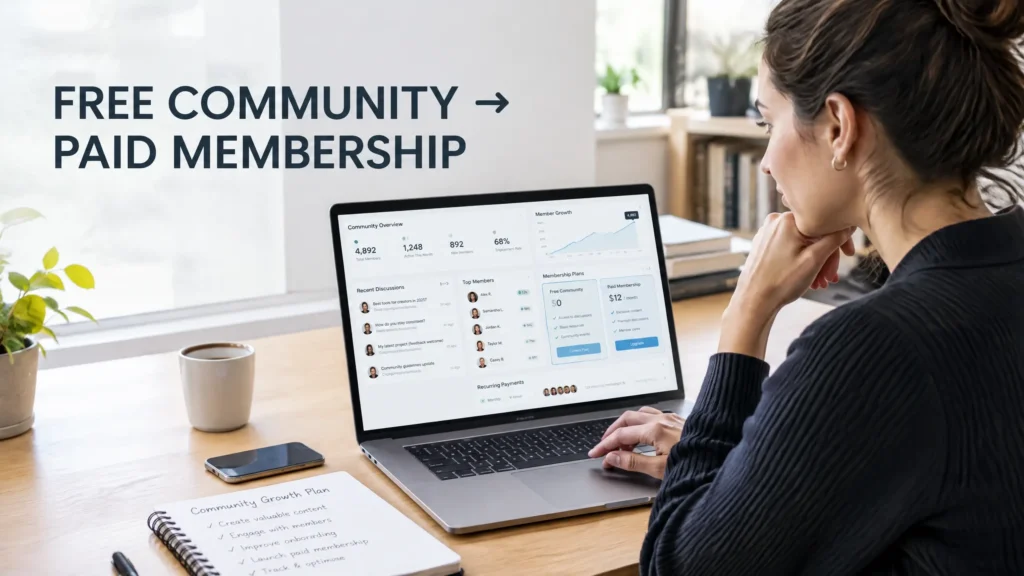

Building a successful online presence takes more than social posts; it requires a dedicated space where your people gather, connect, and get real value. Too many creators rely on shifting algorithms instead of owning a community platform they control. That makes sustainable membership and recurring revenue hard to achieve.
In this guide you’ll learn a clear, practical path to convert a free group into a paid membership community: how to define your ideal member, design a premium experience that justifies a fee, and use data to scale your membership over time. Read on for the six-step plan and real examples that show how community monetization works in practice. (Estimated read: 12 minutes.)
Platforms like Mighty Networks make it easier for creators and businesses to launch a branded community, centralize content, and deepen relationships with members. With the right approach, you can turn engagement into predictable income while giving members the control and access they want.

Key Takeaways
- Moving from a free group to a paid model lets you build a sustainable business around your community.
- Define an ideal member to create membership tiers and a premium experience that delivers value.
- Use simple metrics and member feedback to scale while protecting your brand and control of the platform.
- Owning your community platform reduces dependence on social algorithms and improves retention.
- Small, engaged member bases can generate meaningful recurring revenue when you focus on value and experience.
Understanding the Shift from Free to Paid Membership Models
Moving an online community from free to paid is not just about adding a price tag it’s about improving the member experience, sharpening your value proposition, and aligning your model with what people are willing to pay for. Before you switch, you need to measure current engagement and understand the signals that indicate readiness.
Key indicators to check before you monetize: engagement rate (posts, replies, reactions), retention (how many members stay month-to-month), and member satisfaction (surveys or NPS). Use those metrics as a baseline so you can track progress after you introduce a paid tier.
When you adopt a revenue-generating model, keep these benefits and trade-offs in mind:
- Active engagement: Paid communities often show higher participation because members have skin in the game in some cases platforms have reported substantial increases in activity after introducing paid features.
- Quality connections: Charging for access shifts the focus from vanity metrics to meaningful relationships and deeper discussions.
- Member investment: People who pay for membership contribute more consistently, improving the overall community dynamic.
- Control and value: Owning your community platform gives you greater control over experience, pricing, and member access essential for long-term monetization.
Micro-case: a professional Slack group for product managers introduced a modest $10/month tier with exclusive AMAs and templates; within three months, engagement metrics rose and voluntary contributions increased. (Tip: document your baseline metrics so you can quantify the lift.)
Action checklist measure your current state this week:
- Calculate weekly active members (WAU) and engagement rate.
- Run a short satisfaction survey or single NPS question.
- List 3 exclusive benefits you could offer paid members in month 1.
- Decide a test duration (30–90 days) and target conversion rate.
The Fundamentals of a Paid Membership Community
A strong membership community is built on relationships and clear value, not just gated content. Members pay because the community delivers access, accountability, and connections they can’t easily find elsewhere. Focus on designing interactions and experiences that make membership indispensable.
Core elements to get right:
- Entry & standards: Define who the community is for and set criteria or tiers so members feel aligned and committed.
- Member-driven value: Encourage members to share ideas, case studies, and resources member contributions create network effects that scale value.
- Expert access: Provide regular touchpoints with subject-matter experts (AMAs, office hours, coaching) so members get fast, actionable help.
- Experience over content: Prioritize formats that spark discussion and relationship-building rather than one-way broadcasts.
Example spectrum: at the high end, Tiger 21 is often cited as a membership community with strict entry requirements and high fees that deliver peer networks and private advice (verify current numbers from public reporting). At the other end, niche paid coaching groups with 50–200 members charge modest monthly fees and focus on practical templates, live workshops, and peer accountability.
What to measure (early KPIs): retention rate, contribution rate (percent of members who post or reply each month), average revenue per member (ARPM), and lifetime value (LTV). Track these metrics monthly to see whether your membership, pricing, and benefits are creating measurable value for members.
Why Community Monetization Matters in Today’s Market
Turning a free online community into a paid membership can change your business economics: you trade chasing large audiences for building a smaller, engaged base that reliably pays for access, advice, and community. Paid communities can deliver steady revenue while improving member retention and perceived benefits.
Platform data often shows the advantage of focused paid offerings. For example, according to platform reports, a meaningful share of creators who add subscriptions earn four-figure months from relatively few members demonstrating that targeted membership pricing can outperform broad-reach strategies.
To put this into perspective, use a simple formula: required paid members × price per month = target monthly income. For instance, 26 members paying $40/month yields $1,040/month; 100 members at $10/month yields $1,000/month. This makes clear how pricing, member count, and retention drive revenue and why monetization strategy matters more than raw follower numbers.
- High-value coaching and dedicated support become easier to justify when members pay for access, increasing perceived benefits.
- Paid community models shift your marketing focus from reach to retention and member outcomes, which typically improves long-term revenue.
- With a clear pricing strategy and measured experiments, you can forecast monthly income and iterate quickly for example, test pricing tiers for 30–90 days and compare conversion and churn.
Steps to Grow a Paid Community from an Existing Free Group
Turning a free group into a paid membership community requires planning, testing, and clear communication. Start by strengthening trust and value for your current members — that foundation makes asking for payment much easier to justify.
Below is a practical, ordered checklist you can follow to grow a paid community from your existing free group.
- Audit your community now. Measure engagement (posts, replies, reactions), weekly active members, and retention. Document baseline numbers so you can measure lift after you launch a paid tier.
- Identify paid benefits. List three exclusive offerings you can deliver in month one (examples: weekly expert AMA, searchable resource library, smaller mastermind cohorts).
- Build a minimum viable membership (MVM). Create one paid tier with a clear set of benefits and modest pricing. Keep the initial scope small so you can iterate quickly.
- Run a pilot with existing community members. Invite a limited cohort (early adopters) at a discounted rate for 30–90 days. Ask for feedback and testimonials you can use in marketing.
- Communicate value clearly. Announce the change in multiple places (email, pinned posts, onboarding flows). Use messaging that explains what stays free, what’s new, and why the paid tier improves the experience for community members.
- Test pricing and offer structure. A/B test a low and a mid-tier price, or offer annual vs monthly plans. Track conversion and churn to determine the best pricing model.
- Scale gradually. Once the pilot shows positive metrics, open enrollment in controlled cohorts to preserve culture and deliver support without overloading your team.
Example: Mindbody manages a large free community that supports product adoption and retention — use your free group the same way: as the top of the funnel and a place to recruit engaged community members into paid tiers. (If you reference Mindbody’s member counts, confirm the latest figures before publishing.)
Template invite message (short): “We’re launching a paid membership to offer deeper coaching, exclusive tools, and small-group sessions. Want early access at a discounted rate? Click to join the pilot.” Use that message in DMs, email, and a pinned post.
Helpful next steps this week:
- Calculate your WAU and engagement rate.
- Draft the 3 initial paid benefits.
- Choose 10–30 early adopters for a 30-day pilot and invite them.
Video:
for a step-by-step pilot playbook.
Defining Your Ideal Member and Membership Value
Identifying the right audience is the most important step in building a thriving membership community. When you clearly define who your ideal member is, you can design benefits and pricing that match the outcomes they want — and members will pay for measurable value.
Examples illustrate how specificity raises perceived value. For instance, Shaan Puri has promoted communities focused on eCommerce founders who hit higher revenue thresholds — a narrow focus can justify premium pricing and stronger networking. Similarly, Nancy Anderson grew a fitness brand by targeting postpartum women with tailored workouts and peer support; that niche focus attracted members who valued the shared experience.
Setting entry requirements or creating clear tiers such as by job title, revenue, or experience level helps members know what to expect and preserves the quality of interactions. Focus your membership on one or more of the enduring markets (wealth, health, relationships) to make benefits tangible and easy to communicate.
Pricing guideline (example): if your community helps members increase income or save time, a $100 monthly fee can be justified when the average member gets a clear ROI. Start with a pilot price, measure results, and iterate based on feedback.
Example membership types and what they offer
| Example Entry Requirement Value Proposition | ||
| Shaan Puri’s eCommerce Group (example) | $1M annual revenue (example) | High-value networking and curated deals |
| Nancy Anderson’s Fitness Community (example) | Postpartum focus (example) | Targeted support, routines, and peer accountability |
| Professional Development Network (example) | Industry-specific roles (example) | Skills, mentorship, and income growth opportunities |
Three quick qualifying questions to define your ideal member:
- What specific result does this person want in 90 days? (income, health, client growth)
- What minimum experience, role, or revenue level makes the group useful for them?
- How much time per week can they realistically contribute or engage?
Simple tier-test CTA: launch a 30-day pilot with two tiers (basic and premium) and invite 20–50 existing members. Offer the premium tier at a trial price, collect feedback, and track retention and value metrics before you fully roll out pricing.
Crafting a Premium Experience for Your Online Community
Paid members pay for an experience, not just content. Delivering a premium experience means making access effortless, interactions meaningful, and support reliable whether members log in from a desktop or catch up on the train via mobile.
Here’s a compact UX checklist to optimize your membership community quickly:
- Simple onboarding: 1–2 minute welcome flow, clear first action (introduce yourself, complete profile, or join an intro thread).
- Clear navigation: group hubs, events, resources, and search must be easy to find.
- Fast access: mobile-friendly pages, push notifications for important updates, and downloadable resources for offline use.
- Branded touches: polished visuals, consistent microcopy, and a professional tone that signals value.
- Support pathways: obvious help links, FAQ, and a community advocate or moderator for quick questions.
Two UI/UX micro-examples you can copy:
- Onboarding flow: After signup, show a short modal: “Welcome choose your interest (1–3). We’ll show the best groups and events.” This increases time-to-first-post and activation.
- Smart push: Send one push notification within 24 hours: “Welcome! New members are in say hi in Introductions.” Then send a weekly digest highlighting top discussions and a single CTA (RSVP to event).
Design and copy matter — amateur design reduces trust and increases churn. Invest in a simple style guide (logo usage, colors, font sizes, tone) and a 1-page onboarding script for moderators so new members feel welcomed and know how to get value fast.
Quick A/B test suggestion: run two onboarding variants for a month Variant A asks new members to introduce themselves; Variant B assigns them a suggested action (download a template or RSVP to an event). Measure first-week engagement and new-member retention to see which improves activation.
Focus on removing friction around access and coaching: schedule regular group coaching calls, make recordings easy to find, and create short “how to” videos so members use their time efficiently. These details help members perceive real value for the time and money they invest.

Proven Strategies for Community Monetization
Monetization works best when members drive value. Encouraging contributions, running events, and offering ongoing coaching turn a paid community into a predictable revenue engine. Treat the community like a product: design features, measure KPIs, and iterate based on member feedback.
Turn these strategies into repeatable playbooks with clear steps and metrics:
- Member contributions (playbook): Create contribution prompts, highlight top posts weekly, and reward creators with perks (discounts, free months, visibility). KPI: percent of active members posting each month (target: increase by 10–20% in first 90 days).
- Events and discussions (playbook): Host a mix of formats — live workshops, AMAs, and small-group masterminds. Cadence example: 1 large event + 2 small-group sessions per month. KPI: event attendance rate and post-event engagement.
- Ongoing support and coaching (playbook): Offer structured coaching (office hours, curriculum-based cohorts) and ensure recordings/resources are searchable. KPI: retention rate for members using coaching vs non-users.
Quick templates you can use now:
- Event format: 45-minute value session (20 min teaching, 20 min member Q&A, 5 min CTA to resources or paid offer).
- Survey question to refine offers: “What single outcome do you want most from this community in 90 days?” (Provide 3–4 options + open text.)
- Pricing rationale snippet: “This tier costs $X/month because members receive Y hours of coaching, Z templates, and monthly small-group access proven to reduce time-to-result by N%.”
Immediate experiment (CTA): run a paid workshop this month with an upsell to a 3-month cohort. Track sign-ups, conversion to cohort, and short-term retention. Use the results to inform pricing and predict revenue.
| StrategyStepsKPI | ||
| Member Contributions | Weekly prompts → highlight posts → reward top creators | % of members posting monthly, DAU/MAU |
| Events & Discussions | Plan calendar → promote → run + follow-up resources | Attendance rate, engagement after event |
| Ongoing Support | Schedule coaching → record sessions → provide templates | Retention rate, NPS for coached members |
Remember: a paid community is a business. Prioritize measurable revenue outcomes (monthly recurring revenue, average revenue per member) alongside softer metrics like relationships and member satisfaction. Iterate quickly and let the data guide which monetization strategies you scale.
Leveraging Content Marketing to Fuel Community Growth
Content marketing is the engine that attracts new people and keeps existing members engaged. A predictable content rhythm creates anticipation, establishes your brand voice, and gives members clear reasons to return all essential for community growth.
Implementing a Consistent Content Calendar
Aim for one major piece of content per week (long-form post, webinar, or video) and smaller daily touchpoints (short posts, discussion prompts). Consistency trains members to expect value and increases the chances that members will share your content and invite others.
Sample weekly content calendar (easy to copy)
- Monday: Long-form article or newsletter (thought leadership + CTA to community).
- Wednesday: Short post with a discussion prompt (drives comments and member posts).
- Friday: Member spotlight or case study (shows real outcomes and social proof).
- Monthly: Live video or webinar with Q&A (use this to convert interested people into members).
Adapting Content Across Multiple Platforms
Repurpose one core asset into many formats: turn a 45-minute webinar into a long-form article, 3 short videos, and 5 social posts. Pick one platform to master first (LinkedIn for B2B, Instagram or TikTok for consumer audiences, YouTube for long-form educational videos) and adapt content to each platform’s format and audience.
Innovative Content Strategies for Maximum Reach
Use member success stories, behind-the-scenes videos, and live events to create authentic marketing that appeals to potential members. Repurpose aggressively: clips become social posts, quotes become graphics, and transcripts become searchable resources inside your community.
30-day content experiment (CTA): Publish one major piece per week and repurpose it across three platforms. Track these KPIs: content views, new member signups from content, engagement rate (comments/shares). After 30 days, double down on formats and platforms that drive the most growth.

Utilizing Tools and Platforms for Effective Community Management
Choosing the right platform is one of the fastest ways to improve member experience and reduce operational overhead. A good community platform gives you control over branding, payments, and member data — which matters when you’re building a membership business that needs predictable revenue and scalable support.
Use this simple vendor checklist when evaluating platforms:
- Must-haves: reliable payment processing, member profiles, private messaging, event/calendar features, and basic analytics.
- Nice-to-haves: mobile apps with push notifications, content modules (courses, libraries), single sign-on (SSO), and native community discovery.
- Support & compliance: clear support SLAs, GDPR/CCPA compliance, and easy export of member data for backups and migrations.
Decision matrix (quick): match your priorities to platform capabilities if retention and mobile access are top goals, weight mobile app and push notifications higher; if monetization is primary, prioritize payment flexibility and subscription management.
Practical tips for platform selection and migration:
- Run a 30-day trial with a small group of members to test onboarding, event flows, and payments.
- Request case studies from the vendor that match your business size (e.g., communities with 100–5,000 members).
- Create a migration checklist: export member data, communicate timeline to members, schedule content import, and freeze signups during the switch to avoid data loss.
Examples and context: some vendors and developer partners (e.g., Breakthrough Apps) help creators process large payment volumes and build custom features verify specific claims and figures with vendors before publishing. Ultimately, investing in the right platform lets you automate routine tasks, free up time to support members, and scale your community to thousands of members when the product-market fit is proven.
Overcoming Challenges in Sustaining a Paid Membership Model
Keeping a paid community healthy takes ongoing attention. The biggest threats are content churn, falling perceived value, and member attrition all of which directly hit recurring revenue. The good news: with a few repeatable processes you can reduce churn, raise engagement, and protect your business.
Start by treating risks like a short risk register: identify likelihood, impact, and a mitigation you can implement this week.
| RiskLikelihoodImpact on businessImmediate mitigation | |||
| Content churn (no fresh value) | Medium | Reduces recurring revenue | Publish a monthly plan, re-run high-performing sessions, and invite member-led content. |
| Member churn (cancelations) | Medium | Lowers MRR & changes community dynamics | Automated re-engagement flow + exit survey to capture reasons for leaving. |
| Value perception drops | Low–Medium | Harder to sell renewals | Quarterly value reports and member spotlights showing outcomes. |
Concrete strategies to increase engagement and retention:
- Proactive engagement: Run weekly prompts, welcome new people publicly, and seed conversations so community members feel invited to participate.
- Welcome advocates: Assign moderators or paid community advocates to onboard new members, answer questions, and escalate issues quickly.
- Seek and act on feedback: Use short pulse surveys and NPS to spot issues early; publish a visible backlog of member requests and status updates.
KPIs to track daily/weekly/monthly:
- DAU/MAU (daily & monthly active users) monitor trends week over week.
- Churn rate monthly cancellations divided by starting members.
- Activation (first-week engagement) percent of new members who take a first meaningful action in 7 days.
- LTV and ARPM — to understand the financial impact of retention changes.
Sample re-engagement email (short): “We miss you here’s what’s new this week: [1-sentence highlight]. If you have 2 minutes, tell us one thing we could do to bring you back.” Link to a one-question survey and a replay of a recent high-value session.
Operational tips: automate routine support tasks (welcome messages, access issues), empower advocates to handle common questions, and reserve time each week for member outreach a 15-minute daily check-in can prevent many problems before they grow.

Conclusion
Building a paid membership begins with a clear promise: deliver ongoing value that members can’t easily get elsewhere. With intentional design, reliable delivery, and a member-first mindset, you can turn a free group into a sustainable membership that supports your brand and business growth.
Three immediate next steps you can take today:
- Define: Write a one-sentence description of your ideal member and the single outcome your community delivers (e.g., “Busy founders who want 3 new customers in 30 days”).
- Test: Run a 30–90 day pilot with a small cohort, measure activation and retention, and collect direct feedback.
- Launch: Roll out a minimum viable membership tier, communicate value clearly, and iterate based on the metrics you tracked during the pilot.
Want a shortcut? Download a simple checklist or use the 30-day content and pricing experiment templates in this guide to accelerate growth. Focus on member contributions, refine your content marketing, and invest in a platform you control those three levers will increase perceived value and protect recurring revenue as your community scales.
Start with these steps, keep the emphasis on relationships and outcomes, and your membership can become a reliable source of income and long-term value for the people it serves.
FAQ
What are the key benefits of transitioning from a free group to a paid model?
A paid model funds better support, exclusive content, and structured experiences that increase member commitment. It also lets you invest in a community platform you control, improving the long-term value for members and predictable revenue for your business. Read more: see “Why Community Monetization Matters.”
How can I determine the right pricing for my membership?
Base pricing on the outcomes and time savings members receive, not just your costs. Test two price points in a 30–90 day pilot, track conversion and churn, and use member feedback to refine tiers. Read more: see “Defining Your Ideal Member and Membership Value.”
What strategies can I use to increase engagement in my paid community?
Run regular events, encourage member-generated posts, and create small-group cohorts or coaching to deepen relationships. Use prompts, member spotlights, and rewards to sustain contribution rates. Read more: see “Proven Strategies for Community Monetization.”
How do I maintain a sense of community among paid members?
Keep interactions personal: welcome new people, recognize contributions, and run regular live sessions that foster two-way discussion. A clear onboarding flow and active community advocates help new members find their place quickly. Read more: see “Crafting a Premium Experience.”
What types of content are most effective for attracting new members?
High-value formats include webinars, case studies, tutorials, and member success videos. Repurpose each long asset into short posts and clips to reach people across platforms and drive them into your online community. Read more: see “Leveraging Content Marketing.”
How can I leverage social media to promote my paid community?
Share success stories, short video clips, discussion highlights, and targeted ads that point back to a lead magnet or free sample inside your group. Focus on platforms where your audience already spends time, and include clear CTAs to join or watch a free event. Read more: see “Content Marketing” and “Steps to Grow a Paid Community.”
What are some common pitfalls to avoid when starting a paid community?
Avoid launching with vague benefits, neglecting onboarding, or overpromising results. Don’t rush to scale before you prove retention and value; keep expectations clear and communicate changes proactively. Read more: see “Overcoming Challenges in Sustaining a Paid Membership Model.”
How can I measure the success of my paid community?
Track member retention, engagement metrics (DAU/MAU, posts, replies), revenue growth (MRR, ARPM), and LTV. Combine quantitative metrics with regular member surveys to capture satisfaction and areas for improvement. Read more: see “Steps to Grow” and “Overcoming Challenges.”
How can I start a paid community today?
Start small: define your ideal member, create a minimum viable membership with one clear benefit, and invite 20–50 existing members to a paid pilot. Measure activation and retention, collect testimonials, and iterate before a full launch. Download the planning checklist in this guide to follow a proven 30–90 day path.