
Hey there! If you’re reading this, you probably already know that the internet is getting louder every single day. The big social media feeds feel like crowded stadiums where everyone is shouting, but nobody is really listening. I felt that exact same way a few years ago. I was exhausted from chasing viral trends and trying to appeal to the masses. That’s when I discovered the magic of micro-communities. These are the quiet, cosy living rooms of the internet. They’re small, focused groups where people actually talk to each other.
But here’s the thing: getting people to engage in these small spaces is completely different from getting likes on a massive public feed. In a micro-community, you don’t just want views. You want shares. You want saves. You want real conversations. Today, I’m going to share the exact post formats that get the most shares in these tight-knit groups. I’ll also dive into the science of why we crave this connection, and yes, I’ll share a rather embarrassing story about how I completely messed this up when I first started.
Let me take you back to my first real attempt at building a micro-community. I had set up a private Discord server for freelance writers. I was so excited. I had about fifty people join in the first week. I thought I had it all figured out. I treated that small, intimate space exactly like I treated my public Twitter feed.
Every morning, I would drop a highly polished, broadcast-style post. I used corporate language. I shared links to my own articles without asking any questions. I was essentially standing in a small room with a megaphone, shouting at people who just wanted to have a conversation.
The result? Absolute crickets. People stopped logging in. The few who did stay never shared anything I posted. I felt like a total failure. I sat on my couch one evening, staring at my laptop, feeling completely defeated. I had spilt a glass of water on the table, and I just let it sit there while I realised my mistake. I was talking at them, not with them. A micro-community is not an audience; it’s a neighbourhood. Once I changed my approach and started using the formats I’m about to share with you, everything changed. The engagement skyrocketed, and members started sharing the content with their own networks.
My Big Mistake: The “Megaphone” Failure
The Science of Connection: Why Micro-Communities Matter
Micro-communities resonate so deeply with us because the need for connection isn’t just a nice-to-have; it’s deeply biological, a fundamental human need vital for our overall well-being. Think about it: from the earliest days of humanity, we’ve thrived in tribes and communities. Our brains are literally wired for social interaction.
The National Alliance on Mental Illness (NAMI), a leading mental health organisation, consistently highlights how community provides a profound sense of belonging, crucial support systems, and a clear sense of purpose [1]. When you feel accepted, understood, and valued within a group, it validates your self-worth in ways that individual achievements often can’t. This isn’t just about feeling good; it has tangible health benefits.
Consider the stark warnings from medical research. The National Institutes of Health (NIH) has extensively documented that social isolation and chronic loneliness are far more than just unpleasant feelings. They are serious public health risks, comparable to obesity and smoking. Studies show that prolonged social isolation can increase your risk of developing dementia by a staggering 50% and elevate your risk of heart disease and stroke by 30% [2] [3]. These aren’t minor correlations; they’re significant threats to our long-term health.
The Centers for Disease Control and Prevention (CDC) echoes these concerns, noting that a lack of social connection puts individuals at heightened risk for a range of severe physical and mental health conditions [3]. It’s a silent epidemic that many are only now beginning to fully grasp.
On the flip side, being an active part of a strong, supportive community acts as a powerful protective buffer against these negative health outcomes. A compelling study published in the National Center for Biotechnology Information found that individuals who reported a higher sense of community in their neighbourhoods experienced significantly fewer symptoms of depression, anxiety, and stress [4]. Imagine that: your social connections directly impacting your mental resilience.
Furthermore, the physical benefits are equally impressive. Strong community ties have been consistently linked to lower blood pressure, healthier cholesterol levels, and a reduced risk of mortality overall [5]. It’s clear: our social lives are intertwined with our physical health.
So, when people are actively seeking out and joining micro-communities, they’re not just looking for a hobby group or a networking opportunity. They are, often subconsciously, seeking these protective, supportive environments. They crave a safe space where they can be vulnerable, share ideas, and feel truly seen. As content creators and community builders, when we facilitate genuine human connection within these groups, we’re not just marketing; we’re contributing to the fundamental well-being of our members. This understanding is the bedrock of creating content that truly resonates and gets shared.
The Post Formats That Drive Shares
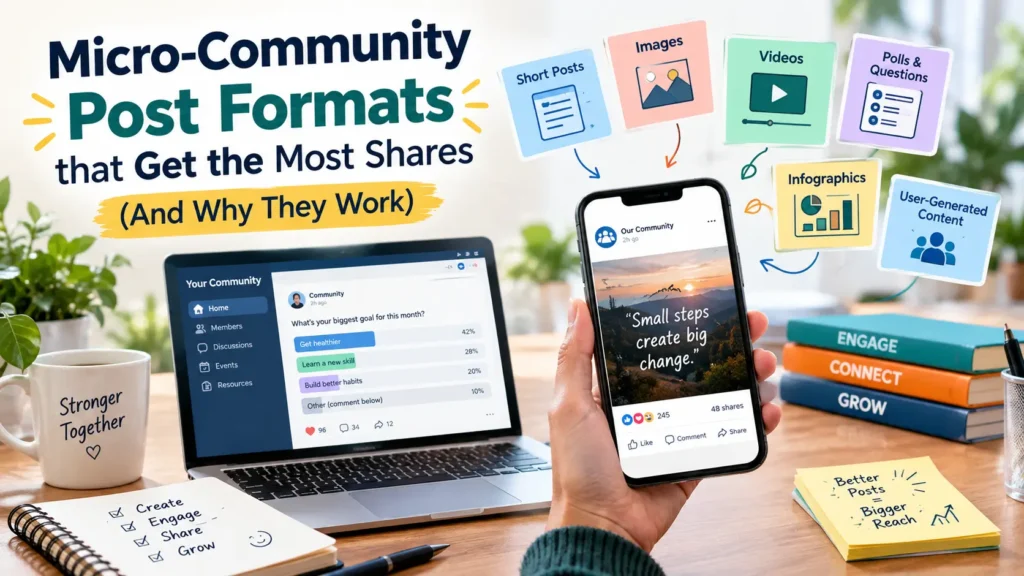
Understanding the ‘why’, let’s explore the ‘how’. In micro-communities, a share is the ultimate compliment—content resonated so deeply a member vouches for it. These formats drive most shares:
1. The “Unpopular Opinion” or Nuanced Take
To truly get your content shared, you often need to challenge the prevailing norms within your niche. The “Unpopular Opinion” format is a masterclass in doing just that. It works by first identifying a widely accepted belief or piece of advice within your micro-community and then respectfully, but firmly, questioning it. The key isn’t to be contrarian for the sake of it but to offer a nuanced perspective that most people haven’t considered.
For instance, instead of a generic post like, “Consistency is key on social media,” you could craft an “Unpopular Opinion” post that reads: “Unpopular opinion: Daily posting can actually harm your brand if you don’t have a solid community engagement strategy in place.” This immediately grabs attention because it goes against conventional wisdom. You then follow up by explaining why you hold this opinion, providing evidence, personal anecdotes, or logical reasoning.
This format is a sharing magnet because it sparks either strong agreement or healthy debate. Those who secretly harbour the same “unpopular” thought will share it to validate their own feelings and find like-minded individuals. Those who disagree might share it to challenge your perspective, inviting discussion within their own networks. Either way, it creates movement, conversation, and ultimately, shares. The golden rule here is to always keep it respectful, focus on the ideas, and avoid personal attacks. It’s about intellectual curiosity, not conflict.
2. The Educational Carousel
Educational carousels are pure value bombs, consistently driving high engagement on visual platforms like Instagram [6]. But don’t limit yourself! You can absolutely adapt this format for text-heavy platforms like LinkedIn, or even as a meticulously threaded post in Discord or Slack. The magic lies in its structured approach to delivering actionable information.
Here’s how to structure it for maximum shareability:
•Strong Hook (Slide/First Line): Grab attention immediately with a compelling question, a bold statement, or a promise of a solution.
•Digestible Steps (Subsequent Slides/Lines): Break down a complex topic into bite-sized, easy-to-understand chunks. Use bullet points, short paragraphs, and clear headings.
•Real Examples (Throughout): Illustrate your points with concrete, relatable examples. Show, don’t just tell.
•Clear Takeaway/Call to Action (Final Slide/Line): Summarise the main benefit or tell people exactly what to do next. This could be to try a new strategy, ask a question, or share the post.
People share these posts because they are highly actionable and serve as a valuable resource. When a community member encounters a well-structured guide that solves a specific problem or teaches a new skill, their immediate thought is often, “Oh, my friend/colleague needs this!” They become a curator of valuable information, enhancing their own reputation within their network by sharing their content.
3. The “Be Honest” Vulnerability Post
This format, the “Be Honest” Vulnerability Post, was a game-changer for my micro-community. It literally saved it from becoming a ghost town. The core principle here is authenticity. In smaller, more intimate online spaces, people crave genuine connection, not polished perfection. A “Be Honest” post is where you bravely share a struggle, a failure, a moment of doubt, or a behind-the-scenes look at something that didn’t go perfectly.
For example, you might share a screenshot of a failed marketing campaign and dissect what went wrong or talk about a time you felt crippling imposter syndrome despite external successes. The crucial next step is to invite community members to share their own experiences, creating a safe space for mutual vulnerability.
This format works wonders because it dramatically lowers the barrier to entry for conversation. When you, as the community leader or a prominent member, show vulnerability, you give others implicit permission to do the same. It humanises the experience, fostering deep empathy and understanding. Members share these posts, often tagging others in private messages or direct replies, saying things like, “Finally, someone gets it!” or “Look, we’re not the only ones dealing with this.” This shared acknowledgement of struggles strengthens bonds and transforms casual members into deeply connected advocates.
4. The Community Spotlight
Nothing builds loyalty and a sense of belonging faster than shining the spotlight on someone else. The Community Spotlight format is incredibly powerful because it shifts the focus from you, the content creator, to the invaluable members of your micro-community. It’s a direct way to show appreciation and acknowledge the contributions that make your community special.
This format involves taking a member’s success story, an insightful question they posed, a thoughtful comment they made, or even a small win they shared, and turning it into a dedicated post. You highlight their contribution, explain its value to the broader community, and crucially, you tag them directly. This isn’t just a nice gesture; it’s a strategic move.
This format is a guaranteed share. When you feature someone, they are almost certainly going to share that post with their own network – their friends, family, and professional connections – to proudly show off their recognition. This not only brings new eyes to your community but also acts as a powerful testimonial.
Beyond the individual share, it signals to the rest of the community that you are paying attention. It proves that the space is truly about the members, not just the creator. It encourages everyone else to participate more actively, hoping they might be featured next. It creates a positive feedback loop where engagement is rewarded, fostering a vibrant and self-sustaining environment.
5. The “Famous Person” Framework
This format is all about borrowing credibility and leveraging existing interest in your niche. The “Famous Person” framework involves analysing a recognisable figure, a successful brand, or a compelling case study that is relevant to your micro-community. You then dissect their successes, failures, or specific strategies, extracting actionable lessons that your community members can apply to their own endeavours.
For instance, in a community for aspiring writers, you might craft a post titled, “What Stephen King understands about building a writing habit that most new authors miss. ” Or, in a marketing community, “How Nike built a cult following: Lessons for your micro-brand.” The goal isn’t just to talk about these figures but to provide a deep dive into why their methods work or don’t work and how your community can learn from them.
This format is a sharing powerhouse because it combines the inherent appeal of a recognisable name with the practical value of your analysis. People are naturally curious about successful individuals and brands. When you offer a fresh, insightful perspective on their journey, it becomes highly shareable. It’s educational, but the familiar subject matter makes it far more engaging than a dry tutorial. Community members will share these posts because they offer a shortcut to wisdom, allowing others to learn from the best (or from their mistakes) without having to do all the research themselves. It positions you as a knowledgeable curator and analyst, further cementing your authority within the niche.
How to Encourage the Share
Formats are half the battle; fostering a natural sharing environment is crucial. My strategies:
First, ask for shares strategically. Frame it around value: “If you know a freelancer struggling with client boundaries, send this their way.” This targets specific readers, increasing share likelihood.
Second, engage with engagers. Reply to comments and publicly thank sharers. Valued interactions encourage future engagement and sharing.
Finally, apply the 80/20 rule: 80% helpful, educational, or community-focused content; 20% promotional. Avoid constant sales pitches; consistent value turns members into advocates.
Frequently Asked Questions (FAQ)
Here are common questions about micro-communities:
Q: What is a micro-community?
A: Small, focused groups (30-100 members) built around shared interests.
Q: Best platforms?
A: Discord/Slack for real-time chat; Facebook Groups/Reddit for discussions; WhatsApp/Telegram for quick updates.
Q: How often to post?
A: Consistency over frequency. Two thoughtful prompts weekly are better than daily generic links.
Q: Why no engagement?
A: You might be talking at them. Ask open-ended questions, show vulnerability, and focus on their interests.
Q: How to measure success?
A: Track saves, shares, DMs, and comment depth. 50 active members are more valuable than 5,000 silent followers.
Q: Can it grow my business?
A: Yes. Engaged communities build trust, leading to brand advocacy, content sharing, and loyal customers.
Conclusion: Build the Living Room
Micro-communities aren’t about virality; they’re about creating safe, valued, and heard spaces—trading stadiums for living rooms. Focus on formats sparking real conversation: nuanced opinions, vulnerable stories, community spotlights. This builds genuine human connection, a desperate need, as medical research shows. Stop shouting. Ask better questions. Share failures. Highlight members. Serve your community, and shares, saves, and growth will follow.
References
1. National Alliance on Mental Illness. (2019, November 18). The Importance of Community and Mental Health. https://www.nami.org/Blogs/NAMI-Blog/November-2019/The-Importance-of-Community-and-Mental-Health
2. National Institutes of Health. (2020). Social Isolation and Loneliness in Older Adults. https://pmc.ncbi.nlm.nih.gov/articles/PMC7437541/
3. Centers for Disease Control and Prevention. (2024, May 15). Health Effects of Social Isolation and Loneliness. https://www.cdc.gov/social-connectedness/risk-factors/index.html
4. National Center for Biotechnology Information. (2023). Sense of community and mental health: a cross-sectional analysis. https://pmc.ncbi.nlm.nih.gov/articles/PMC10314672/
5. Psychology Today. (2023, July 18). The Importance of Community. https://www.psychologytoday.com/us/blog/what-the-wild-things-are/202307/the-importance-of-community
6. Social insider. (2026, February 13). How to Master Community Engagement on Social Media?. https://www.socialinsider.io/blog/community-engagement-social-media/