
Running an online fitness community is tough work. I know this because I have been doing it for years. The biggest hurdle is not getting people to sign up. The biggest hurdle is keeping them active.
When people join a new fitness group, they are full of motivation. They post their selfies, they share their meal prep, and they hit every workout for the first two weeks. But then, life happens. The motivation fades. The posts slow down. The community goes quiet.
I have seen this happen too many times. I have built communities that thrived for a month and then died a slow, silent death. It is frustrating. You put so much energy into creating a space for people to grow, and watching it go quiet feels like a personal failure.
But here is what I have learned: the secret to keeping an online fitness community alive is not just giving people a workout plan. The secret is giving them a reason to show up every single day. And the best way to do that is through creative challenges.
Challenges create a sense of urgency. They create a shared goal. They give people a reason to post, comment, and support each other.
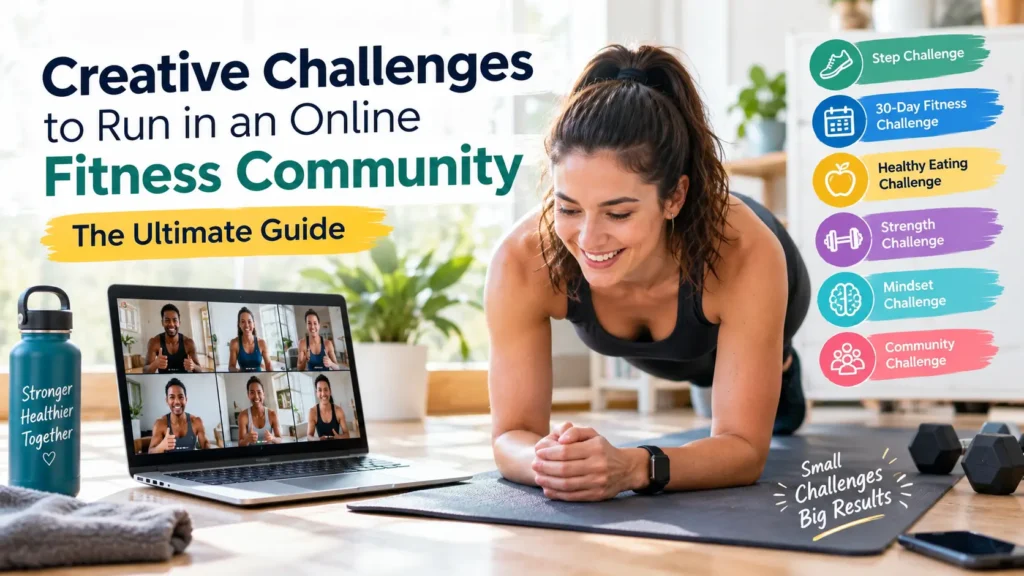
In this guide, I am going to share the exact creative challenges I use to keep my online fitness communities engaged, active, and growing. I will also share the science behind why they work and a personal failure story so you can avoid my biggest mistake.
The Science Behind Group Fitness Challenges
Before we dive into the specific challenges, we need to understand why they actually work. It is not just about making things fun. It is about behavioural psychology.
When you exercise alone, you rely entirely on self-motivation. Self-motivation is a finite resource. It runs out. But when you exercise as part of a group, you tap into a different energy source: social accountability.
A study published in PLOS One examined the effects of social support and reward on exercise performance. The researchers found that social factors were strongly associated with greater subjective enjoyment and energy. More importantly, higher subjective energy was associated with faster run times, without any corresponding increase in perceived effort.
In other words, when we feel connected to a group, we actually work harder and enjoy it more. We perceive the effort as being lower than it actually is.
Another study published in Sports Medicine – Open looked at exercise adherence from a behavioural perspective. The authors noted that focusing on the immediate, short-term purposes of exercise like hitting a daily step goal or completing a challenge with friends can significantly increase motivation. They argued that the repetition of these short-term, socially supported behaviours is what leads to long-term habit formation.
1. The “First 5” Movement Challenge
One of the biggest barriers for beginners in an online community is intimidation. They look at the 45-minute HIIT workouts or the heavy lifting programmes and think, “I can’t do that.”
This is why I love the “First 5” challenge.
The premise is incredibly simple: commit to just 5 minutes of intentional movement every day for 30 days.
It does not have to be a gruelling workout. It can be a gentle yoga flow, a quick walk around the block, or five minutes of stretching while the coffee brews.
Here is why it works so well in an online community:
•Low Barrier to Entry: Anyone can do 5 minutes. It removes the excuse of “not having enough time”.
•Focus on Consistency: The goal is not intensity; the goal is showing up. It trains the brain that exercising is just something we do every day, like brushing our teeth.
•High Engagement: In my communities, this challenge always generates the most comments. People post videos of their 5-minute routines, share their favourite walking trails, and cheer each other on for simply showing up.
When people see that the hardest part is just starting, they often find that their 5 minutes turn into 15 or 20. But we never tell them that at the beginning. We just focus on the first 5.
2. The Collective Step Count Challenge
Individual step challenges can be motivating, but they can also be discouraging for people who are just starting out. If someone is used to walking 2,000 steps a day, seeing a goal of 10,000 steps can feel overwhelming.
The solution? Make it a team effort.
In a Collective Step Count Challenge, you divide your community into teams. The goal is for the entire team to hit a massive, collective number within a specific timeframe. For example, “Team A, your goal is to walk 1 million steps in 14 days.”
I have run this challenge dozens of times, and it is always a hit. Here is how I structure it:
1. Assign Teams: Put people together based on time zones or fitness levels, or mix them up for variety.
2. Set the Math: If a team has 10 people, a 1 million-step goal means each person needs to hit 100,000 steps over 14 days (about 7,100 steps a day). That is highly achievable.
3. Daily Check-ins: Require everyone to post their step count screenshot or data in the team’s designated thread every evening.
4. Celebrate the Milestones: When the team hits 25%, 50%, and 75% of their goal, celebrate loudly in the main community channel.
The beauty of this challenge is that it fosters genuine teamwork. If someone has a bad day and only gets 3,000 steps, the rest of the team steps up to cover the gap. The pressure is off the individual, but the accountability remains high.
3. The “Hydration and Sleep” Streak Challenge
I have a confession to make. When I first started running online fitness challenges, I thought the only thing that mattered was sweat. If people were not exhausted, I assumed they were not working hard enough.
I created a challenge called “30 Days of Brutal Strength”. The goal was to lift heavy and finish every workout drenched in sweat. I posted the plan, hyped it up, and waited for the engagement to roll in.
Here is my personal failure: it was a complete disaster.
Within three days, the community went quiet. People were skipping workouts because they were sore. They were skipping workouts because they were busy. They were skipping workouts because the challenge demanded 100% effort every single day, and life rarely allows for that.
I had created a challenge that burnt people out instead of building them up. I learned a hard lesson that day: fitness challenges should be about building sustainable habits, not about proving how much pain you can endure.
Since that failure, I completely changed my approach. I now run challenges that focus on the foundational pillars of health that are often ignored: hydration and sleep.
The “Hydration and Sleep” challenge asks participants to track two simple metrics daily:
•Drink a specific amount of water (e.g., half your body weight in ounces).
•Get in bed 15 minutes earlier than usual to wind down.
Participants simply post a green checkmark in the group chat when they hit both goals. No workout photos. No sweat. Just basic health habits.
This challenge works beautifully because it is low-effort but high-impact. It reminds people that fitness is not just about what you do in the gym; it is about how you recover outside of it. It also keeps the community active on rest days, which is crucial for maintaining momentum.
4. The “Mobility First” Bingo Card
If you have been in a fitness community for a while, you know that people love to compete. But individual competition can sometimes breed jealousy or insecurity.
That is why I love using a fitness bingo card.
Imagine a standard 5×5 bingo grid. Instead of numbers, the squares contain different mobility or recovery tasks. For example:
•Top row: 5 minutes of foam rolling, 10 minutes of yoga, do the splits (or attempt them), stretch your hip flexors, do a deep squat hold for 30 seconds.
•Middle row: Take a rest day, drink 3 litres of water, do 10 minutes of breathing exercises, massage your feet, etc.
The goal is to complete a full row, a full column, or a full card within a month.
This challenge is fantastic for several reasons:
• It Provides Choice: Participants can choose which squares to tackle based on their schedule and how their body feels.
•It Focuses on Recovery: Mobility and recovery are often neglected by beginners. This challenge educates them on the importance of these practices.
•It Sparks Conversation: People will post pictures of their attempts to do the splits or their foam rolling setup, asking for advice and sharing tips.
It turns the often-boring task of stretching into a fun, gamified experience.
5. The Team Target Tracker
Sometimes, you want to inject a little friendly rivalry into your community. A points-based leaderboard is a great way to do this.
In the Team Target Tracker challenge, you assign points to various activities. For example:
• Completed a workout: 5 points
•Hit 10,000 steps: 2 points
•Prepared a healthy meal: 3 points
•Posted an encouraging comment: 1 point
You can divide the community into teams, or you can just run it as an individual leaderboard. The key is to update the points daily and post the leaderboard in a pinned post.
This challenge works well because it rewards effort and consistency, not just intensity. Someone who does a light 20-minute walk gets just as many points for that workout as someone who does an intense 20-minute run. It keeps the playing field level.
I usually pair this challenge with a reward at the end. The winning team or individual gets a small prize, like a gift card to a sports store or a free one-on-one consultation. The prize is a nice bonus, but the real motivation is the public recognition on the leaderboard.
6. The “Mindful Minutes” Challenge
Fitness communities can sometimes become toxic environments where everyone is obsessed with aesthetics and performance. If you are not careful, your community can start to feel like a pressure cooker.
To counter this, I run a “Mindful Minutes” challenge every quarter.
This challenge asks participants to spend 5 to 10 minutes a day doing something specifically for their mental health. This could be meditation, journaling, deep breathing, or simply sitting in silence with a cup of tea.
We do not track reps or calories. We just track time.
This challenge is vital for the long-term health of your community. It teaches people that taking a mental break is just as important as taking a physical break. It also fosters a deeply supportive environment, as people will often share their struggles with stress and anxiety, and the community will rally to support them.
How to Structure a Successful Challenge
Having a good idea is only half the battle. Executing the challenge well is what makes it successful. Here is my simple framework for running any challenge:
1. Keep it short: 14 to 30 days is the sweet spot. Anything longer than a month becomes a chore, and people drop out.
2. Make it Visible: Create a dedicated space for the challenge. A specific Facebook group, a Slack channel, or a hashtag if you are using Instagram.
3. Provide Daily Prompts: Do not just launch the challenge and disappear. Post a prompt every morning. Ask a question, share a tip, or post a motivational quote. You need to be the active host.
4. Celebrate the Small Wins: When someone hits day 10, celebrate it. When someone completes their first bingo card, celebrate it. Recognition is the fuel that keeps the engine running.
Conclusion: The Power of Shared Goals
An online fitness community is only as strong as its members’ engagement. If they are not talking, sharing, and supporting each other, the community will die.
Creative challenges are the antidote to silence. They give people a reason to log in, a reason to interact, and a reason to push themselves a little further.
Whether you are running a “First 5” movement challenge to build consistency, a “Hydration and Sleep” streak to teach recovery, or a team-based bingo card to add some fun, the goal is the same: to create a shared experience.
When people feel like they are part of a team working toward a common goal, the results are incredible. The motivation is high, the accountability is real, and the community thrives.
Stop trying to be the only source of motivation in your group. Build challenges that allow the members to motivate each other. That is when the real magic happens.
Frequently Asked Questions
What is the best length for an online fitness challenge?
The ideal length for an online fitness challenge is between 14 and 30 days. Anything shorter than two weeks does not provide enough time to build a habit, while anything longer than a month often leads to participant burnout and a drop in engagement.
How do I keep people engaged if they are not winning the challenge?
Engagement should not be limited to just the winners. To keep everyone involved, celebrate milestones (like completing 50% of the challenge), encourage participants to post about their struggles and ask for advice, and use gamification like a bingo card where everyone can achieve a small win.
Can I run a fitness challenge for complete beginners?
Absolutely. In fact, challenges are perfect for beginners. The key is to set a very low barrier to entry. Challenges like the “First 5” movement (just 5 minutes of activity) or a hydration streak focus on consistency rather than intensity, making them accessible to everyone.
What tools do I need to manage an online fitness challenge?
You do not need expensive software. A simple Facebook group, a WhatsApp group, or a Slack channel works perfectly. You can use free tools like Google Sheets to track points for a leaderboard and social media hashtags to gather progress photos.
How do I handle a participant who drops out of a challenge early?
Do not single them out or make them feel guilty. The best approach is to gently re-engage them. Send a private message checking in on them, or post a general message in the community encouraging everyone to recommit to the challenge, no matter where they are in the process.
References
[4] MyPTHub. (2026). Fitness challenge ideas for personal trainers: inspire your clients in 2026.
[5] Club OS. (2021). 5 Ready-to-Go 30-Day Challenges to Promote Club Community Wellness.
Final Thoughts on Community Building
Building an online fitness community is not just about sharing workout routines. It is about creating a space where people feel seen, supported, and motivated.
When you introduce creative challenges, you are not just giving people a goal to achieve. You are giving them a reason to connect with each other. You are giving them a reason to show up, day after day, even when their motivation is low.
Remember my failure with the “30 Days of Brutal Strength” challenge. I focused too much on intensity and not enough on accessibility. By shifting my focus to challenges that are inclusive, fun, and focused on sustainable habits, I have seen my communities thrive in ways I never thought possible.
So, take a look at the challenges I have outlined here. Pick the one that best fits the needs of your community. Set it up, promote it, and watch the magic happen.
Your community is waiting for its next big challenge. Are you ready to give it to them?
Disclaimer: This article is for informational and educational purposes only. It does not constitute medical or fitness advice. Always consult a qualified healthcare professional or certified fitness trainer before starting any new exercise programme or health challenge.