
11 min read
Let me be honest with you.
A few years ago, I spent six months trying to build a community inside a Facebook group. I promoted it constantly. I showed up every single day. I posted questions, started discussions, and ran giveaways. And after all that effort, the engagement was… fine. Not great. Fine. People scrolled past. Comments trickled in. Nobody really talked to each other.
I thought I was doing something wrong. Turns out, I was just using the wrong platform.
Once I moved my audience to a dedicated community app, things actually changed. People started introducing themselves without being prompted. They tagged each other. They came back without being reminded. The difference was night and day.
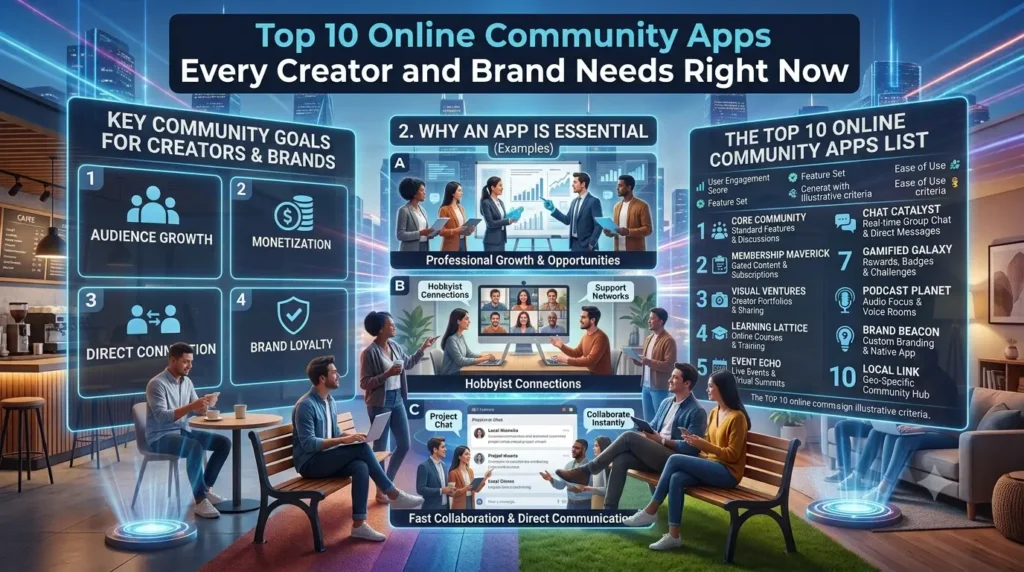
So if you are a creator, a freelancer, a coach, or a brand trying to build something real around your work, this list is for you. These are the 10 best online community apps available right now. I have either used all of them personally or spent serious time evaluating them. I will tell you what each one is actually good for, what it is not good for, and who I think should be using it.
No fluff. Just what you need to know.
Why Your Choice of Platform Matters More Than You Think
Before we get into the list, I want to make one point.
The platform you build your community on shapes how your community behaves. That is not an opinion. That is just reality.
A platform that buries posts in an algorithm teaches people to scroll, not connect. A platform built around real-time chat encourages quick conversations but makes it hard to find information later. A platform built around structured courses and content helps people learn but might not feel warm or social.
There is no single perfect platform. But there is a right platform for your specific goal. Keep that in mind as you read through this.
1. Discord
Best for: Creators, gaming, tech communities, and anyone who wants free and powerful
Discord was originally built for gamers. Now it is used by everyone from indie creators to Fortune 500 companies. And for good reason.
It is completely free. You can create unlimited channels, organize them by topic, set up different roles for different types of members, and even run voice or video rooms. The mobile app is solid. The desktop app is even better.
What I love about Discord is the flexibility. You can build an entire layered community for zero dollars. Want a channel just for your paying members? Done. Want a voice room where people can drop in and chat while they work? Easy. Want a bot that welcomes new members automatically? There are hundreds of free bots for that.
The downside? It has a learning curve. For some audiences—especially older professionals—Discord can feel confusing at first. The interface is not the most intuitive if you have never used it before. And unless you actively design the structure well, new members often get lost.
My honest take: Discord is the best free option on this list by a wide margin. If your audience is tech-comfortable and under 40, start here.
Pricing: Free, with optional paid Nitro upgrades for members.
2. Circle
Best for: Coaches, course creators, and paid communities
Circle is probably my personal favorite right now. I switched to it about two years ago, and I have not looked back.
It is purpose-built for online communities. That means it has everything you actually need—spaces for discussions, member profiles, events, a live streaming feature, DMs, and even a course builder—all inside one clean interface. No cobbling together five different tools.
What sets Circle apart is how polished it feels. Your members land on something that actually looks professional. There are no distracting ads, no algorithmic nonsense pushing other content in their face. It is just your community.
The one drawback is price. Circle is not cheap, especially once your community grows. But if you are running a paid membership, the pricing is very reasonable relative to what you get.
Pricing: Starts at $89/month. Higher tiers unlock more features.
3. Mighty Networks
Best for: Course + community combo, membership businesses
Mighty Networks has been around since 2017, which makes it one of the veterans on this list. And they have kept improving it.
The big thing Mighty Networks does well is combining courses, events, and community in one place. If you are a creator who sells courses AND wants a community around those courses, this is worth a serious look. Members can go from watching a lesson to jumping into a discussion thread without ever leaving the platform.
They also have a native app builder, which means your community can have its own branded iOS and Android app. That is a serious advantage for branding. Your members are not opening some generic platform—they are opening your app.
The trade-off? The interface is a little clunky in places. It does a lot of things, but it does not always do all of them smoothly. Setup takes time. And some of the more advanced features require their higher-priced plans.
Pricing: Starts at $41/month on the Courses plan. The full platform with monetization features runs higher.
4. Skool
Best for: Course creators who want simplicity
There is a community feed, a classroom section for courses, a member leaderboard (which people love more than you would expect), and a calendar for events. That is basically it. But it works really well.
The leaderboard feature is a nice touch. Members earn points for contributing to the community. It turns engagement into something slightly addictive, in a good way. People come back because they want to keep their streak or climb the leaderboard.
Where Skool falls short is customization. You cannot do a lot to make it look or feel like your brand. It looks like Skool. That might bother you or it might not, depending on how important visual branding is to your audience.
I would recommend Skool for anyone launching their first paid community. It removes almost all the decision fatigue.
Pricing: $99/month flat. They take a 2.9% transaction fee on paid communities.
5. Slack
Best for: Professional teams, B2B brands, and work-adjacent communities
Slack gets used as a team communication tool at most companies. But a lot of creators and brands have started using it for communities too.
Here is why it works: if your audience is already using Slack at work, they know exactly how it functions. There is almost no onboarding friction. They can set up notifications the way they want, mute channels, and search past conversations. It feels familiar.
Slack communities work particularly well in B2B settings—think marketing communities, developer communities, and startup founder groups. The format fits the way those people already work.
Where it does not work as well is in consumer creator communities. Most general audiences do not want another workspace app. Slack can also feel a little cold and businesslike, which is not great if you are trying to build warmth and connection.
Pricing: Free plan available with limits. Paid plans start at $7.25/user/month.
6. Geneva
Best for: Lifestyle brands, creative communities, younger audiences
Geneva is a newer platform and one I think is criminally underrated.
Think of it as Discord with better design. It has group chats, channels, audio rooms, and private messaging—but the interface is cleaner and more visually appealing. It also has a discovery feature that makes it easier for new people to find your community organically.
I tested Geneva with a small creative writing group. The vibe was immediately different from every other platform I have used. It felt more like a social space and less like a productivity tool. People just… talked. Without needing to be nudged.
The platform is still growing, which means some features are not as polished as established competitors. But the potential here is real. If your audience skews younger or creative, Geneva is worth experimenting with.
Pricing: Currently free for communities.
7. Telegram
Best for: News, announcements, content drops, and global audiences
Telegram often gets overlooked in these conversations. I think people associate it with privacy nerds or crypto communities. But it is actually a very capable community tool.
The broadcast channel feature alone is worth your attention. You can send messages to thousands (or millions) of subscribers instantly, with no algorithm deciding who sees it. If you post something, your subscribers get it. Simple as that.
Telegram also supports group chats with up to 200,000 members, polls, file sharing, voice chats, and bots. The international reach is impressive—Telegram is massive in Asia, the Middle East, and Eastern Europe. If any part of your audience is outside North America, Telegram is probably already where they hang out.
The weakness? It is not great for structured discussion or content organization. Everything is chat-based and linear. Old posts get buried. It works better as a broadcast tool or a casual hangout than a structured learning community.
Pricing: Free. Premium plan available at $4.99/month for individuals.
8. Facebook Groups
Best for: Audiences that are already on Facebook
I know. I know. I literally opened this post by talking about how Facebook Groups failed me. So why is it on this list?
Because it still works for a lot of people.
Here is the thing. Facebook Groups failed ME because I was using them wrong. I was treating it like a professional community platform when it is really just a feature inside a social network. Once I accepted that—and started using it as a way to reach people who were already spending time on Facebook—it made more sense.
If your target audience is 35–65 years old, Facebook Groups is still where they live. Small business owners, hobby communities, parent groups, and local neighborhood circles—they are all still thriving on Facebook. It is free, it requires zero setup, and your members do not need to download anything new.
What I would not use it for: a paid premium community, a course-based experience, or an audience of professionals under 35. For those use cases, the other platforms on this list will serve you better.
Pricing: Free.
9. Beehiiv
Best for: Creators who want community + newsletter in one place
Beehiiv started as a newsletter platform. Over time, they added community features. Now it is a genuinely interesting option for creators who want to connect their content distribution with their audience engagement.
Here is why this matters. Most community platforms exist in isolation from where people discover your work. Beehiiv connects the dots. You write a newsletter. Your subscribers read it. And then they can come into your community space to discuss it. All inside the same ecosystem.
The community features are not as deep as Circle or Mighty Networks. But if you are a writer, journalist, or content creator whose main output is a newsletter, the integration is a real advantage. Your audience does not have to jump between different apps.
Beehiiv is also growing fast, which means the product is improving regularly. Worth keeping a close eye on if newsletters are central to your work.
Pricing: Free plan available. Paid plans start at $42/month.
10. WhatsApp Communities
Best for: Personal brands, local businesses, and global reach
Yes, WhatsApp. Bear with me.
In 2022, WhatsApp launched “Communities”—a way to organize multiple WhatsApp groups under one roof, with announcement channels and subgroups for specific topics. For a lot of creators outside the US, this is genuinely the most practical community tool on this entire list.
WhatsApp has over 2 billion users globally. In India, Brazil, Nigeria, the UK, and most of Latin America, WhatsApp is where people live on their phones. If your audience is in any of these regions, meeting them where they already are is a massive advantage.
The limitations are real: limited media organization, no structured course features, and no real analytics. But the ease of entry for your members cannot be matched. Zero download required. Most people already have it. They understand how it works.
For local businesses, personal brands with international audiences, or anyone who just wants a low-friction way to stay connected with their most engaged followers, WhatsApp Communities deserves serious consideration.
Pricing: Free.
How to Actually Choose the Right One
Here is a simple framework I use.
Ask yourself three questions:
1. Who is my audience? Young and tech-savvy? Consider Discord or Geneva. Professionals? Try Slack or Circle. General public, older demographic? Facebook groups or WhatsApp.
2. What do I want people to do in my community? Learn something? Mighty Networks or Circle. Chat and hang out? Discord or Geneva. Stay informed? Telegram or WhatsApp.
3. What is my budget? No budget? Start with Discord, Geneva, Telegram, Facebook Groups, or WhatsApp. Ready to invest? Circle, Mighty Networks, or Skool.
Do not try to be on all of them at once. Pick one. Build it properly. See if it works. Then decide if you want to expand.
One More Thing
The app you use matters. But it is not the most important thing.
The most important thing is showing up consistently for the people inside your community. The best platform in the world will go quiet if the person who started it stops caring.
I have seen communities thrive inside simple Facebook groups because the creator showed up every single day, answered questions, started real conversations, and made people feel seen. And I have seen beautifully designed Circle communities become ghost towns because the creator set them up and then disappeared.
Build it somewhere that makes sense for your audience. Then show up. That is really the whole strategy.
Have you tried any of these platforms? I would love to hear what has worked for you—drop a comment below.