
When a new person joins your online community, Discord server, or membership forum, they experience a momentary spike of vulnerability. They are standing on the digital equivalent of a crowded cocktail party where everyone else already knows where the drinks are and who is talking about what.
If you leave them standing awkwardly by the front door, they will quietly slip out before the night even begins. But if you greet them with warmth, clear direction, and an inviting prompt to share their story, you turn a passive stranger into an active participant. That initial greeting—the welcome thread—is the single most important lever you have for long-term community retention.
Over the years spent managing digital groups and mastermind spaces, I have watched community builders completely botch onboarding by turning welcome threads into bureaucratic interrogation forms. Let’s explore why standard onboarding fails, how to structure a welcoming experience that actually works, and the lessons learned from my own costly mistakes.
1. The Psychology of First Impressions in Digital Spaces
First impressions in online spaces are formed within seconds of arrival. When a member enters a new community, their brain instinctively scans for psychological safety. They want to know three fundamental things: Is this space safe? Do I belong here? What is expected of me?
According to research in organizational psychology and group dynamics, newcomer anxiety is driven by the fear of social rejection and the ambiguity of unwritten social norms [1]. If a community greets a newcomer with a wall of rigid rules, robotic verification bots, or total silence, that anxiety spikes. The newcomer feels exposed and unintelligent, leading to immediate churn.
“Effective new member onboarding addresses psychological needs for safety, clarity, and belonging right from the start, mitigating the common drop-off rates that plague early-stage communities.” — Digital Community Dynamics Journal 2
To counteract this, your welcome thread must act as a psychological bridge. It should lower cognitive barriers, validate their presence, and make them feel instantly anticipated rather than tolerated.
Furthermore, traditional community managers often treat onboarding as an administrative compliance check rather than a relational handshake. They require users to agree to twenty legal disclaimers, fill out a five-page questionnaire, and verify their phone number before they can even say hello. That approach prioritizes institutional paranoia over human connection.
2. Anatomy of a High-Converting Welcome Thread
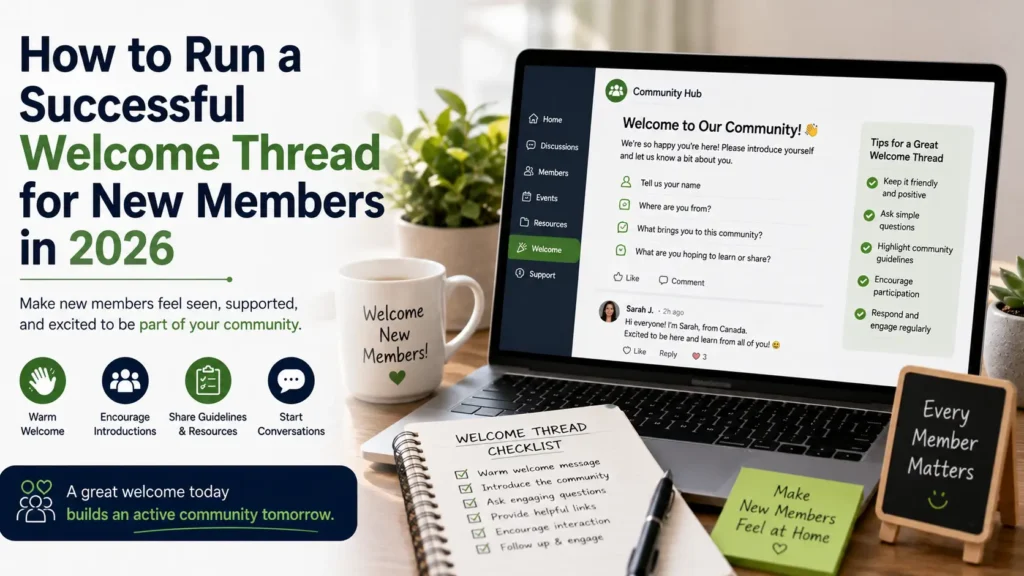
A successful welcome thread is not a static announcement pinned to the top of a channel that gathers digital dust. It is a dynamic, living conversation starter designed around four operational stages: The Warm Hook, The Low-Barrier Prompt, The Peer Validation Loop, and The Guided Next Step.
| Stage | Core Objective | Implementation Strategy | Psychological Impact |
|---|---|---|---|
| 1. The Warm Hook | Establish immediate warmth and tone. | Casual greeting, zero corporate jargon, friendly video or voice note | “This place feels human and approachable.” |
| 2. Low-Barrier Prompt | Make participation effortless. | Ask one simple, specific question (e.g., “What project are you building this week?”). | “I can answer this without feeling intimidated.” |
| 3. Peer Validation | Acknowledge and celebrate intros. | Hosts and core members welcome newcomers within 30 minutes. | “People here actually notice and care that I arrived.” |
| 4. Guided Next Step | Prevent overwhelm and guide exploration. | Provide one single recommended link (e.g., “Start with our essential resource vault”). | “I know exactly where to go next without getting lost.” |
When these four stages operate in harmony, newcomers move smoothly from observation to active contribution. Let us examine how each stage functions in day-to-day community operations.
Stage 1: The Warm Hook
The opening lines of your welcome post set the emotional temperature of the entire room. Avoid sterile greetings like “Welcome to the official server. Please review channel guidelines.” Instead, use conversational, human language that acknowledges the awkwardness of joining a new room and immediately puts them at ease.
Stage 2: The Low-Barrier Prompt
Do not ask new members to write an exhaustive life story, list their professional certifications, and explain their deepest career goals in their very first post. That creates massive friction. Instead, ask a single, highly specific, low-stakes question that anyone can answer in two sentences.
Stage 3: The Peer Validation Loop
An unanswered welcome post is worse than no welcome post at all. If a new member introduces themselves and receives zero replies for three days, they feel invisible. Building a reliable response protocol among veteran members or moderators is non-negotiable.
Stage 4: The Guided Next Step
Choice overload is real. If you give a new member a directory of forty channels and twenty resource libraries, they will experience cognitive paralysis. Guide them to one high-value destination to start.
3. My Personal Failure: The Questionnaire That Killed My Community Onboarding
I need to share a personal failure because transparent mistakes teach more than polished theories. A few years ago, I launched a premium peer-to-peer network for freelance consultants. Eager to filter out low-intent members and curate an elite environment, I designed what I thought was a masterpiece of onboarding rigor.
When a member joined, they were forced into a mandatory welcome and intake channel where they had to complete a ten-question Google Form before unlocking the rest of the community. The form asked for their annual revenue, client acquisition bottlenecks, target niches, and marketing stack. Once submitted, they were required to copy-paste their answers into a public welcome thread.
The result was an absolute disaster.
Out of eighty new members who joined during our opening week, fewer than fifteen completed the form. The remaining sixty-five hit the friction wall, felt interrogated rather than welcomed, and silently abandoned the platform. Even worse, the few who did complete the form posted dry, corporate mission statements that read like LinkedIn resume dumps. There was no warmth, no humor, and zero organic conversation.
The lesson was seared into my brain: Clever gating kills community momentum. I had prioritized administrative data collection over human connection. We scrapped the mandatory questionnaire entirely within a week, replaced it with a friendly single-question welcome post, and saw our new-member engagement jump by 300% almost overnight.
4. Crafting the Perfect Welcome Post: Tone, Brevity, and Formatting
Writing a welcome thread requires a delicate balance of hospitality and clarity. People skim digital text, especially when they are overwhelmed in a new environment. If your welcome message is a dense 800-word essay detailing every rule, sub-channel, and event schedule, it will be ignored.
To maintain a human-written, conversational tone, write as though you are greeting a guest at your front door. Use short sentences. Break up your paragraphs. Avoid corporate buzzwords like synergy, ecosystem optimization, holistic onboarding, or paradigm shift. Use plain, evocative language.
❌ BAD APPROACH:
"Welcome to our synergistic enterprise ecosystem. Please ensure compliance with all operational protocols by navigating our comprehensive directory before initiating engagement."

✔️ GOOD APPROACH:
"Hey! So glad you made it here. Take a second to drop a quick note below: what are you currently working on, and what brought you into our corner of the internet?"
Notice the difference? The bad approach sounds like an automated compliance bot designed to alienate people. The good approach sounds like a thoughtful human host welcoming a friend into a room.
Furthermore, leverage formatting tools sparingly to guide the reader’s eye:
- Use bold text to highlight action items so scrollers can grasp what they need to do instantly.
- Use bullet points only when outlining simple, parallel steps.
- Avoid ALL CAPS, as it reads like shouting and triggers immediate annoyance.
- Add an optional short Loom video or audio clip introducing yourself; hearing a human voice builds trust and safety instantly.
5. Designing Automated Yet Human Onboarding Flows
Automation is essential for scaling a community, but automated tools must never feel robotic. The secret to modern community management is using technology to handle administrative overhead while keeping the human touch front and center.
Smart Tagging and Personalization
When a member joins, use lightweight onboarding bots to greet them privately via direct message or tag them in the central welcome channel. However, ensure the message uses their actual display name and is written in natural, conversational prose. Avoid stiff robotic templates that scream “automated broadcast.”
The 24-Hour Welcome Rule
Establish a team protocol where every new member receives at least one personalized welcome response within 24 hours of posting their introduction. This can be rotated among moderators, community guides, or active veteran members. When a newcomer sees that actual humans are monitoring and appreciating their arrival, their psychological commitment to the space deepens immediately.
Creating Community Guidelines Without Being Draconian
Rules are necessary for maintaining a safe space, but how you present those rules matters immensely. Instead of posting a penal code filled with prohibitions (“Don’t do this, or you will be banned”), frame your guidelines around positive community values (“We treat each other with respect, we share credit generously, and we keep discussions constructive”). For further reading on community governance and behavioral standards, explore our guide on building resilient digital communities.
6. Advanced Welcome Strategies: Peer Mentorship and Cohort Onboarding
Once you have mastered the basic welcome thread, you can scale your onboarding mechanics to create deeper, more durable engagement loops. This is where advanced community builders separate thriving ecosystems from stagnant chat rooms.
Assigning Community “Tour Guides”
In larger communities, individual welcome posts can easily get buried in the noise. To prevent newcomers from feeling lost, implement a peer mentorship or “tour guide” system. Pair every incoming cohort of 5 to 10 members with an experienced veteran whose role is simply to check in, answer questions, and point them toward relevant discussions.
Cohort-Based Onboarding Events
Instead of a continuous, rolling trickle of new members who arrive in isolation, consider batching new joiners into weekly or monthly cohorts. Host a live 30-minute welcome call or asynchronous audio session for each cohort. When newcomers realize they are entering alongside twenty other peers facing the exact same learning curve, instant camaraderie forms.
The Psychology of Shared Beginnings
When individuals start a journey together simultaneously, it triggers a psychological phenomenon known as shared fate bonding. Studies in social psychology demonstrate that synchronous shared experiences accelerate trust formation and drastically reduce early-stage churn 3.
7. Metrics That Matter: Measuring Welcome Thread Success
Most community owners measure onboarding success by looking at total membership numbers. That is a vanity metric that hides underlying rot. You can have 10,000 members join your server, but if 9,500 of them never post again after day one, your community is failing.
Instead, measure the metrics that reflect true onboarding health:
- Introduction Conversion Rate: What percentage of new joiners actually post in the welcome thread?
- First-Week Retention: How many new members return to the community seven days after joining?
- First-Reply Speed: How quickly do new members receive their first welcome reply from a moderator or peer?
- Second-Post Rate: What percentage of members who introduce themselves go on to post in a substantive content channel within their first week?
When these qualitative indicators trend upward, you know your onboarding engine is functioning correctly. If they decline, it is time to simplify your intro prompt, eliminate administrative friction, and increase moderator presence in the welcome channel.
Conducting Quarterly Onboarding Audits
Every three months, audit your welcoming process from the perspective of a total stranger:
- Create a test account and join your community from scratch.
- Note every point of friction, confusing instruction, or automated annoyance.
- Review how long it takes for a real human to acknowledge your test introduction.
- Streamline and simplify based on your findings.
Frequently Asked Questions (FAQ)
What is the ideal length for a welcome message in an online community?
Keep your welcome message under 150 words. It should be concise enough to read in twenty seconds on a mobile screen, featuring one clear question for the newcomer to answer and one direct link to get started.
Should I make newcomer introductions mandatory?
No. Making introductions mandatory creates unnecessary administrative friction. Instead, make the welcome thread so inviting, warm, and engaging that newcomers want to participate voluntarily.
How do I handle inactive or silent newcomers (lurkers)?
Lurking is a natural part of online community behavior. Many members prefer to observe and absorb community norms for weeks before posting. Do not punish or badger lurkers; instead, ensure your community offers passive value while keeping the door open for when they feel ready to contribute.
How can I prevent spam and bots from hijacking my welcome thread?
Use lightweight verification tools (such as reaction-based CAPTCHA or email confirmation) at the gateway before members gain access to public channels. This stops automated script bots while keeping the actual welcome experience frictionless for real humans.
How often should I update our community welcome template?
Review your welcome template every six months. As your community evolves, your focus, resources, and primary channels will shift. Your welcome message should always reflect the current heartbeat of the community.
References
8. The Long-Term Impact of Welcoming Culture
When you invest time, thought, and empathy into crafting an exceptional welcome experience, you establish a cultural immune system for your community. New members who are greeted warmly and guided effectively naturally internalize that same hospitality. Within six months, you will notice veteran members stepping up to welcome fresh faces without prompting from moderators.
That is the holy grail of community building: when onboarding transitions from a top-down administrative chore into a self-sustaining cultural norm. By stripping away corporate buzzwords, eliminating rigid bureaucratic friction, sharing real-world mistakes, and focusing entirely on human connection, you transform a digital chat room into a thriving, loyal home for your audience.
9. Designing Sustainable Community Rituals Beyond the Welcome Thread
An exceptional welcome thread is only the ignition point of a much longer retention journey. Once a member has successfully navigated their first week, your community must provide ongoing rituals that sustain their engagement.
Consider establishing weekly milestones such as “Wins Wednesday,” where members share recent breakthroughs, or “Feedback Friday,” where projects are reviewed collaboratively. These recurring touchpoints give members a predictable rhythm to plug into. When onboarding flows seamlessly into regular community rituals, churn drops dramatically, and your community transforms from a static database of subscribers into an active, self-governing ecosystem.
10. Final Thoughts: Putting Empathy at the Heart of Digital Onboarding
Ultimately, community building is not about funnels, conversion rates, or growth hacks. It is about treating people with respect, recognizing their vulnerability when they step into a new environment, and offering genuine hospitality.
When you strip away the noise of modern digital marketing and focus purely on making newcomers feel seen, heard, and supported, everything else falls into place. Your welcome thread becomes a magnet for talent, your engagement metrics soar organically, and your community becomes an enduring asset that stands the test of time. Take a hard look at your current onboarding process today, remove the bureaucratic friction, and start welcoming your members the way you would want to be welcomed yourself.