
Reading Time: 11 minutes
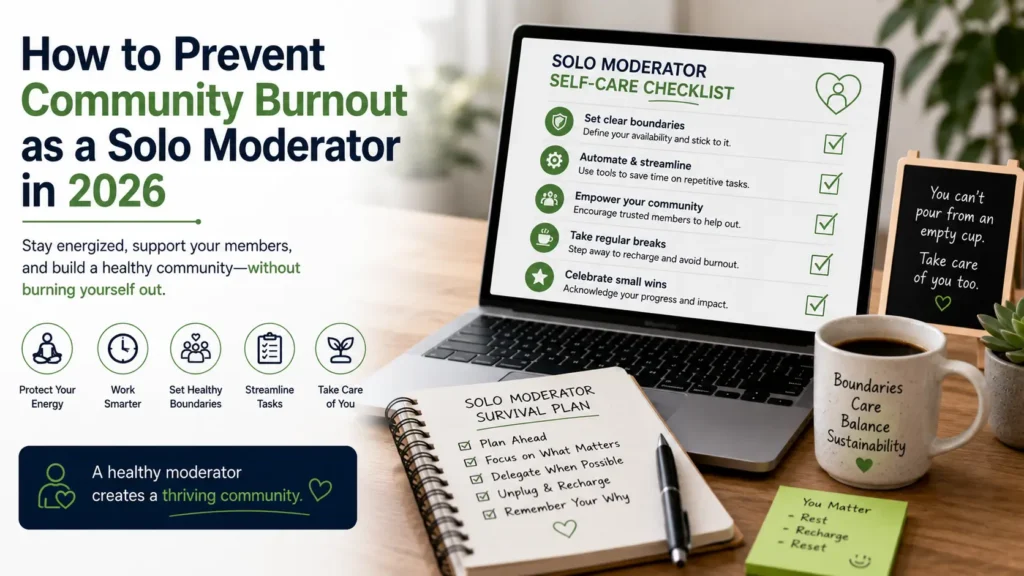
If you are running an online community alone, this guide is for you. Learn practical strategies to prevent burnout, set boundaries, and protect your mental health while keeping your community thriving.
If you are reading this, chances are you are running an online community almost entirely on your own. You are the one setting the rules, answering the questions, handling the disputes, and keeping the peace. It is rewarding work, but it is also incredibly draining.
I know this because I have been exactly where you are right now. A few years ago, I was the sole moderator for a rapidly growing niche forum. I thought that being the only person in charge meant I had total control. What I didn’t realize was that total control also meant total responsibility. When the community hit 10,000 members, I was checking the moderation queue first thing in the morning, right before I got out of bed. By the end of the day, I was still answering messages. I was exhausted, irritable, and dreading every new notification.
I completely ignored the warning signs until I just stopped caring. I stopped replying to messages, ignored rule violations, and felt completely detached from a community I used to love. I had hit a wall. I experienced severe community burnout.
Burnout is not just about being tired. According to the World Health Organization (WHO), burnout is a syndrome resulting from chronic workplace stress that has not been successfully managed. It is characterized by three main dimensions: feelings of energy depletion or exhaustion, increased mental distance from your job, and reduced professional efficacy. 1. In the context of solo community moderation, this means you feel physically drained, you become cynical or detached from your members, and you feel like nothing you do makes a difference.
Christina Maslach, the pioneering psychologist behind burnout research, identified these same three dimensions decades ago. Her work at the American Psychological Association (APA) helped establish burnout as a measurable, real condition that affects millions of workers worldwide. 5. The difference today is that online community moderation has added a new layer of complexity. You are not just dealing with workplace stress. You are dealing with the emotional weight of managing human conflict, handling harassment reports, and being the first line of defence against toxic behaviour on the internet.
A University of Michigan study found that volunteer content moderators experience psychological distress comparable to crisis hotline responders and carers. Think about that. The work you do, the stress you carry, is on the same level as people who answer suicide prevention hotlines. That is not a small thing.
The good news is that burnout is preventable. It is not a permanent state, and you do not have to quit your community to fix it. By making a few strategic changes to how you manage your time and your boundaries, you can protect your mental health and continue to run a thriving online space. In this article, I will share the strategies that saved me, backed by research from the WHO, the APA, and leading academic institutions. I will also share my biggest failure so you can learn from my mistakes.
Recognizing the Early Signs of Burnout
Burnout does not happen overnight. It creeps up on you slowly. The problem is that when you are the only moderator, it is easy to ignore these signs because there is no one else to pick up the slack.
According to Dr. Sue Varma, a psychiatrist and expert on burnout, some of the early warning signs include chronic fatigue, increased irritability, a lack of motivation, and physical symptoms like headaches or changes in sleep.
In a solo moderation context, these signs look a little different. You might recognize yourself in these scenarios:
- The Dread of Notifications: When your phone buzzes, your immediate reaction is anxiety rather than curiosity.
- Resentment Towards Members: You find yourself getting angry at perfectly normal questions that you used to answer patiently.
- Procrastination: You delay opening the moderation queue for days at a time, hoping the problems will solve themselves.
- The “Sunk Cost” Guilt: You feel like you cannot step away because no one else can do the job, so you push through the exhaustion, making the burnout worse.
Recognizing these signs is the first step to fixing the problem. If you see yourself in these descriptions, it is time to make a change before you reach the point of complete exhaustion.
The Power of Setting Clear Boundaries
The most effective way to prevent burnout is to set strict, unbreakable boundaries around your moderation time. Dr. Varma emphasizes that boundaries are essential to protecting your time and energy for the things that matter most. 2.
Here is how you can set boundaries as a solo moderator:
- Define Your “Moderation Hours”: Treat your moderation work like a part-time job. Decide on specific hours when you will check the queue and answer messages. For example, you might decide to moderate from 8:00 PM to 9:00 PM every evening. Outside of those hours, do not log in.
- Communicate Your Availability: Let your community know when they can expect a response. If you tell members that you check messages once a day, they will adjust their expectations. This removes the pressure on you to be instantly available 24/7.
- Turn Off Push Notifications: This is the hardest but most important step. If your phone is constantly buzzing with new posts or comments, your brain is always in “alert mode.” Turn off notifications outside of your designated moderation hours.
In my experience, the guilt of not being immediately available is what drove me to burnout. I felt like if I didn’t fix a problem the second it happened, the community would fall apart. It didn’t. The community survived just fine when I was not staring at my screen.
Letting Go of the Need for Total Control
As a solo moderator, it is natural to want to control every aspect of the community. You set the tone, you enforce the rules, and you guide the conversations. But trying to control everything is a fast track to exhaustion.
A study by the University of Michigan found that volunteer content moderators often experience burnout stemming from time constraints and the constant need to manage toxic online behavior. 3. When you are the only person responsible for this, the burden is overwhelming.
To prevent this, you need to transition from a “controller” mindset to a “facilitator” mindset.
- Empower the Community: Instead of solving every dispute yourself, encourage the members to do it. If two members are arguing, ask the rest of the community to weigh in. Give the power back to the people who actually use the platform.
- Accept Imperfection: Not every rule needs to be enforced perfectly. Sometimes, it is better to let a minor infraction slide rather than spending twenty minutes drafting a warning message.
- Stop Being the Center of Attention: You do not need to reply to every single post. If a member shares an achievement, a simple “like” or an automated badge can be just as effective as a personal congratulatory message.
Automating and Delegating Wherever Possible

You are working with human limits. You need sleep, breaks, and time away from the screen. Technology does not. One of the most effective ways to prevent burnout is to offload as much of the repetitive work as possible to automated tools.
There are many tools available for community platforms like Discord, Reddit, Facebook Groups, and forums that can handle the heavy lifting.
- Auto-Moderation Bots: Set up bots to automatically remove spam, profanity, and off-topic posts. This means when you finally sit down to moderate, you are not wasting time deleting obvious junk.
- Keyword Filters: Create filters for common keywords that often precede rule violations. This can catch problems before they escalate.
- Frequently Asked Questions (FAQs): Create a comprehensive FAQ page or an automated command (like
!helpor/rules) so that members can answer their own basic questions without waiting for you.
By automating the low-level tasks, you free up your mental energy to focus on the things that actually require a human touch, like resolving complex disputes or guiding community events.
Building a Support System
Even if you are a solo moderator, you do not have to be alone. Isolation is a major contributor to burnout. When you are the only person dealing with the stress of moderation, it is easy to feel like you are the only one who understands what you are going through.
Building a support system is crucial for your mental well-being.
- Find a Peer Group: Connect with other community managers or moderators, either on platforms like Reddit, Discord, or LinkedIn. Having a space where you can vent about a difficult user or ask for advice on a tricky situation is incredibly valuable.
- Create a “Trusted Tier”: Identify a few highly active, responsible members in your community. Give them a special role (like “Trusted Member” or “Community Helper”) and privately ask them to help guide new users or de-escalate minor arguments. You don’t have to give them official moderation powers, but their presence can lighten the load significantly.
- Talk to Friends or Family: Explain what you do and the stress it can cause. Sometimes, just venting to someone outside the community helps you gain perspective and reduce the emotional burden.
Prioritizing Your Personal Routine
When you are burnt out, your physical and mental health takes a hit. The American Psychiatric Association (APA) highlights that engaging in self-care is a fundamental strategy for preventing burnout.
Self-care is not about taking a bubble bath; it is about taking intentional steps to nurture your physical, emotional, and mental health. For a solo moderator, this means building a routine that explicitly excludes community management.
Here are some practical ways to prioritize your routine:
- Prioritize Sleep: Aim for 7 to 9 hours of rest per night. Chronic fatigue makes you more irritable and less capable of handling conflict.
- Physical Activity: Exercise is a proven stress reducer. Even a 20-minute walk can significantly lower your stress hormones.
- Mindfulness and Stress Management: Practices like meditation, journaling, or simply sitting quietly for 10 minutes without your phone can help you process the stress of the day.
- Cultivate Hobbies: Have an identity outside of being a moderator. Engage in activities that bring you joy and require sustained focus, which helps you enter a “flow state” and forget about your moderation duties for a while. 2.
When you prioritize your own well-being, you show up better for your community. You cannot pour from an empty cup.
Disconnecting to Recharge
Taking breaks is not a luxury; it is a necessity. The APA recommends scheduling regular breaks and fully disconnecting from work demands. 2.
For a solo moderator, “disconnecting” means stepping away from the community entirely for a set period. This could be a few hours every weekend or a full week-long vacation a few times a year.
- Schedule Time Off: Treat your time off like an appointment that cannot be canceled. Put it on your calendar.
- Set an “Out of Office” Message: Let the community know you will be away and when you will return.
- Do Not Check In: When you are on a break, do not secretly log in to check the queue. This defeats the purpose of the break and keeps your brain in a state of high alert.
By giving yourself permission to disconnect, you allow your mind to reset. You will return to the community with fresh energy, more patience, and a renewed sense of purpose.
My Personal Failure and the Lesson Learned
I want to share a specific failure of mine to emphasize how serious this can be. This is not a story I am proud of, but I think it is important to be honest about what happens when you ignore your own warning signs.
During the peak of my burnout, I was moderating a specialized forum. I was exhausted, resentful, and completely detached. I had stopped setting boundaries and was letting the community dictate my schedule. I was logging in at 6:00 AM before work, checking the queue during lunch, and staying up until midnight resolving disputes. My sleep was suffering, my diet was worse, and I was not exercising at all. My personal relationships were strained because I was physically present but mentally absent.
One evening, a user posted a highly inflammatory, rule-breaking comment in the most active thread. Instead of handling it calmly, I snapped.
I publicly berated the user, lost my temper, and used unprofessional language in a moderator action. It was a massive overreaction driven entirely by my own accumulated stress. The community was shocked. The user was banned, but the tone of the forum shifted immediately. Members became hesitant to post, and the vibrant discussions I had worked so hard to build started dying. Trust, once broken, is incredibly hard to rebuild.
I had failed my community because I failed to take care of myself. I let my burnout dictate my actions, and it damaged the environment I was supposed to protect. The irony is that I thought I was protecting the community by working harder. In reality, my exhaustion was making me the biggest threat to it.
It took me months to recover. I had to publicly apologize, bring on two additional moderators, and completely restructure my workflow. I learned the hard way that your mental health is the foundation of your community. If you crumble, the community crumbles with you. No amount of good intentions can replace a moderator who is physically present but emotionally destroyed.
Balancing Your Life
Ultimately, preventing burnout as a solo moderator is about finding balance. It is about recognizing your limits and respecting them.
A survey by the Community Roundtable found that 50% of community professionals experienced a high degree of burnout over a 12-month period, even when they were optimistic about the future of their community [4]. This shows that passion alone is not enough to sustain you. You need a sustainable workflow. The same survey revealed that while 67% of community programs saw an increase in value, only 34% saw any increase in staffing. The math simply does not add up. More value, more members, more work, but the same number of people doing it.
Here is a quick checklist to help you maintain balance:
- Assess Your Workload: Are you spending too much time on tasks that could be automated?
- Evaluate Your Expectations: Are you holding yourself to an impossible standard of perfection?
- Check Your Boundaries: Are you answering messages late at night? If so, why?
- Prioritize Your Health: Are you getting enough sleep, exercise, and time away from the screen?
- Review Your Rules: Are your community guidelines clear enough that members can self-moderate basic behavior?
- Audit Your Tools: Are you using the moderation features your platform already provides, or are you doing everything manually?
By making these adjustments, you can build a sustainable role for yourself. You can continue to grow your community without sacrificing your own well-being. Remember, you are the most valuable asset in your community. Protect yourself, and your community will thrive.
Final Thoughts
Being a solo moderator is a marathon, not a sprint. The communities that last are the ones where the moderator has learned to pace themselves. The strategies in this article are not about doing less. They are about doing things differently. They are about working in a way that does not slowly destroy you.
Start with one change. Maybe it is turning off notifications after 9:00 PM. Maybe it is setting up a simple auto-mod filter. Maybe it is asking one trusted member to help answer basic questions. Small changes compound over time, and they can make the difference between a sustainable role and a fast track to burnout.
You started this community because you cared about it. That caring is still there. Do not let burnout steal it from you. Protect your energy, set your boundaries, and remember that taking care of yourself is not selfish. It is the most responsible thing you can do for your community.
Frequently Asked Questions (FAQ)
Q: Is it possible to be a successful solo moderator without burning out? A: Yes, but it requires strict discipline. You must set unbreakable boundaries around your time, automate repetitive tasks, and actively manage your stress. Success depends on working smarter, not longer.
Q: How do I tell my community I need a break without them thinking I’m abandoning them? A: Communication is key. Be honest and transparent. Post a message explaining that you are taking a short, scheduled break to recharge. Set an expected return date so they know you are not gone for good.
Q: What if my community members get angry when I don’t reply immediately? A: It is important to manage expectations. If members are demanding instant replies, they have unrealistic expectations of your role. Firmly communicate your availability and stick to it. It is your community, and you get to set the rules for how it is managed.
Q: How do I recruit help if I currently have no other moderators? A: Start by identifying your most active, level-headed members. Privately message them, explain your situation, and see if they are interested in taking on a “Community Helper” role. Give them clear, limited responsibilities to start.
Q: Can burnout from moderating a community affect my real life? A: Absolutely. Burnout is a syndrome that can lead to physical exhaustion, irritability, and detachment in all areas of your life, not just online. If you are feeling these symptoms, it is important to seek support and take a break.
Related Articles
If you found this article helpful, you might also enjoy:
- How to Set Up Community Guidelines That Actually Work — A practical guide to writing rules your members will actually follow.
- Best Free Moderation Tools for Discord Communities — Automate your workflow without spending a dime.
- How to Recruit Your First Community Moderators — Step-by-step guide to finding and onboarding volunteer mods.
- The Mental Health Toll of Social Media: What You Need to Know—Understanding the psychological impact of online spaces.