
I used to think that if I built a paid Substack community, the subscribers would just naturally talk to each other. I thought my paid offer was the content itself, so the community would just be a place for them to hang out.
I was wrong. Dead wrong.
When I first launched my paid tier with the chat feature enabled, I posted a generic “Welcome to the community! Introduce yourself!” message. Then I waited.
I waited for hours. Then days.
The silence was deafening. My paid subscribers were there, but nobody was talking. It felt like throwing a party where everyone just stood around staring at their drinks.
After a few weeks of posting open-ended questions like “What’s on your mind this week?” and getting exactly three replies, I realised something crucial: a community without a host is just an empty room [1].
Substack Chat is not a magic pill that fixes engagement. It is a tool that requires strategy, consistency, and intentional prompting. Over the past year, I have completely overhauled how I use Substack Chat. I went from an abandoned ghost town to a thriving space that actively drives subscriber retention [1].
If you are running a paid Substack community and struggling to get people talking, this guide is for you. I am sharing the exact monthly discussion prompts and frameworks I use to keep my community engaged, connected, and willing to pay for the privilege of being there.
Why Monthly Discussion Prompts Matter More Than Ever
Substack now has over 35 million monthly active subscribers and more than 5 million paid subscriptions across the platform [4]. That means competition is fierce. People are paying for newsletters and communities every day. And they are cancelling just as fast.
The numbers tell a clear story. Subscribers who participate in community threads stay paid longer than subscribers who do not [1]. That is not a coincidence. That is human behaviour.
When someone drops a link to their work and fifteen other subscribers go support it, that person does not cancel. When someone asks a question in a thread and you answer it in front of eighty people, that person tells someone else. When you poll your subscribers on what to build next and then actually build it, they feel like co-owners of what you are doing [1].
That is why monthly discussion prompts matter. They are not just content filler. They are the glue that holds your paid community together. They transform a one-way newsletter into a two-way relationship. And relationships are what people pay for.
Here is what the data from community retention studies shows us:
| Metric | Without Community Engagement | With Active Community Engagement |
|---|---|---|
| Subscriber Churn Rate (Month 3) | 40-50% | 15-25% |
| Open Rate | 40-50% | 60-70% |
| Referral Rate | Low | High |
| Content Ideas Generated | Creator-only | Community-driven |
Member retention strategies should focus on building strong personal connections, delivering clear value, and fostering a sense of belonging [5]. Discussion prompts are the simplest way to achieve all three at once.
The Difference Between Connection and Result Prompts
Before I dive into the specific monthly prompts, you need to understand the two main types of engagement: connection-focused and result-focused [2].
When you are running a paid community, your subscribers are there for different reasons. Sometimes they want to feel seen and supported. Other times, they want accountability and progress. If you only use one type, your community will feel unbalanced.
Connection-focused prompts push for belonging. They make space for people to share their struggles and feel part of a group. Think of them as the prompts that say, “You are not alone.”
Result-focused prompts lean towards goals. They encourage members to reflect, track progress, and celebrate their wins. Think of them as the prompts that say, “Look how far you have come.”
The community weaving framework, developed by community strategist Adrian Robke, adds another layer to this thinking. It asks you to reflect on five things: What brings us together? What holds us together? How do we connect regularly? What roles can we play? How do we journey together? [3].
I use these frameworks every time I write a prompt. They keep me from falling into the trap of asking generic, forgettable questions.
Week 1: The Check-In (Result-Focused)
The first week of the month is all about intention setting and accountability. I use this week to help my paid subscribers focus on their goals. People need structure at the start of a new month, and giving them that structure is one of the best things you can do as a community host.
Prompt Ideas for Week 1:
- “What is one big goal you want to achieve this month?”
- “What is one habit you are committing to building over the next 30 days?”
- “What is the biggest roadblock you anticipate this month, and how will you overcome it?”
- “Imagine you could write a note to yourself on the last day of this month. What would you want it to say?”
I always start by answering the prompt myself. I share a real, vulnerable goal for the month. When subscribers see me being honest about my struggles, they feel safe doing the same [1]. I do not post the prompt and disappear. I stay in the thread for at least sixty minutes after posting, responding to replies and asking follow-up questions [1].
Week 2: The Deep Dive (Connection-Focused)
The second week is where we build trust. This is the week for vulnerability and shared experiences. I want my subscribers to realise they are not alone in their struggles.
Prompt Ideas for Week 2:
- “What is a challenge you are currently facing that nobody talks about in our niche?”
- “Share a recent failure and what you learned from it.”
- “What is one thing you had to unlearn recently to move forward?”
- “What is one unexpected thing that made you smile this week?”
- “Who showed up for you this week in big or small ways?”
This is where the real community magic happens. I have seen subscribers support each other through massive career transitions and personal setbacks during these threads [2]. The Community Musings blog describes this as shifting from “How was your week?” to “What is one thing this week that kept you going despite the uncertainties?” [3]. The second version is dramatically more powerful.
My Personal Failure: The “Weekly Theme” Disaster
I have to admit something. About six months into running my paid chat, I decided to get clever. I wanted to make sure my community stayed engaged, so I created a rigid weekly theme schedule.
Monday: Motivation. Tuesday: Tips. Wednesday: Wins. Thursday: Thoughts. Friday: Fun.
I scheduled these prompts in advance using Substack’s scheduling feature [1]. I thought I had cracked the code. I thought consistency was all I needed.
The result? Crickets.
The prompts felt robotic. They felt forced. People could tell I was just posting to fill a quota, not because I actually wanted to talk to them. The engagement rate plummeted. Subscribers stopped clicking on the Chat tab entirely. After three months of low engagement, my churn rate spiked. People started cancelling their paid subscriptions.
I learnt a hard lesson: consistency is important, but authenticity is non-negotiable.
I scrapped the rigid schedule immediately. Instead, I started looking at what was actually happening in the world, in my own life, and in the community itself. I started asking questions based on real context, not a spreadsheet. I started posting threads that I genuinely wanted to be part of. The engagement bounced back almost instantly.
The key insight here is that an empty chat is worse than no chat at all [1]. If you turn on the feature and go quiet, your paid subscribers will notice. They will feel like they are not a priority. Better to not have it than to have it and abandon it.
Week 3: The Resource Swap (Result-Focused)
The third week is highly practical. Paid subscribers want high value. They want to learn from each other. This week is dedicated to sharing tools, tactics, and strategies.
Prompt Ideas for Week 3:
- “What is one tool or software you cannot live without?”
- “Share a book, podcast, or article that completely changed your perspective recently.”
- “What is the most valuable piece of advice you received this month?”
- “If you could only recommend one resource to someone just starting out, what would it be?”
- “What is a shortcut or hack you discovered recently that saved you hours?”
This week usually results in the highest save rate for the thread, because people are bookmarking the recommendations [2]. I sometimes compile the best responses into a community resource guide and share it back with everyone. That extra step makes people feel like their contributions actually matter.
Week 4: The Reflection (Connection-Focused)
The final week of the month is for looking back. This is where we celebrate progress and acknowledge the journey. I use this week to remind my subscribers how far they have come.
Prompt Ideas for Week 4:
- “What is one thing you are proud of accomplishing this month, no matter how small?”
- “What shifted for you this month, whether it was a perspective, a priority, or a pace?”
- “If you could give one piece of advice to someone at the start of last month, what would it be?”
- “What routine or small habit helped you stay grounded this month?”
- “What is one thing you are letting go of as we head into next month?”
These prompts work because they create closure. They give the month a sense of completion. And closure is what makes people want to stay for the next month.
The Community Weaving Framework in Practice
Here is how I put the Community Weaving Framework into practice every single month [3]. I look at each of the five questions and make sure at least one of my prompts addresses it.
| Framework Question | How I Apply It | Example Prompt |
|---|---|---|
| What brings us together? | Highlight the shared purpose of the community. | “What is one thing that reminds you why you joined this community?” |
| What holds us together? | Celebrate relationships between members. | “Tag someone in this community who helped you recently and tell us what they did.” |
| How do we connect regularly? | Create recurring rituals. | “It is Win Wednesday. What is one win you are claiming this week?” |
| What roles can we play? | Give members leadership opportunities. | “Who wants to host next week’s discussion topic?” |
| How do we journey together? | Reflect on collective progress. | “What is one thing our community has accomplished together this month?” |
The framework keeps me from going on autopilot. It forces me to think about what my community actually needs, not what I think they need.
How to Structure Your Monthly Prompt Calendar
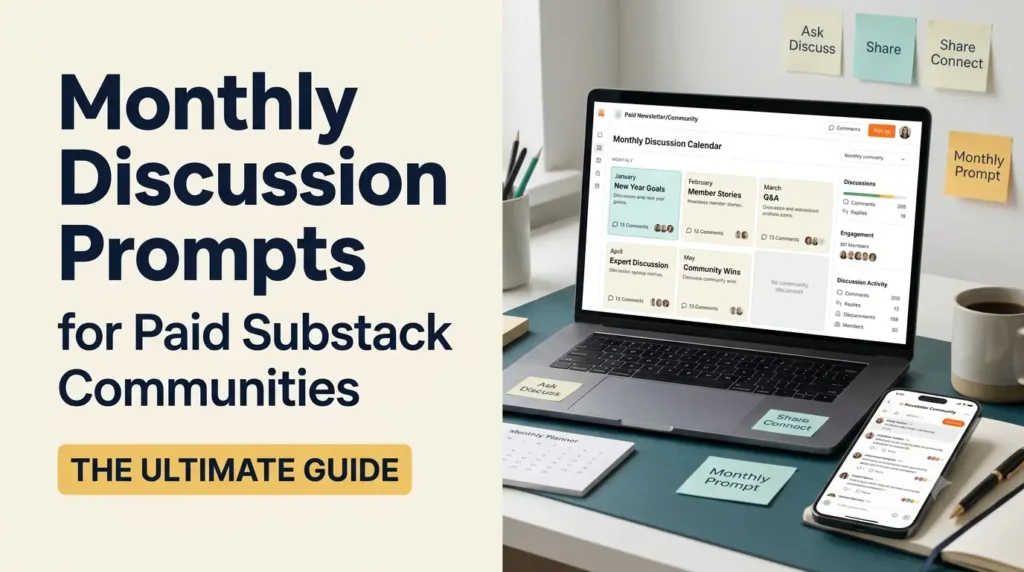
I used to spend hours every week brainstorming prompts. It was exhausting. Then I started batching. Now I sit down for about 45 minutes at the end of each month and write out the discussion prompts for the entire next month.
Here is the structure I follow:
- First week: Result-focused, goal-setting prompts
- Second week: Connection-focused, vulnerability prompts
- Third week: Result-focused, resource-sharing prompts
- Fourth week: Connection-focused, reflection prompts
I write them in a spreadsheet or a notebook. I do not schedule them all in advance, though. I keep them as a bank of ideas. I pick the one that feels most relevant on the day I post it.
Sometimes a breaking news event happens in my niche. Sometimes someone in the community shares something deeply personal. When that happens, I abandon my plan and ask about that instead. The plan is a safety net, not a prison.
I also use the five conversation-sparking strategies that Substack officially recommends [1]:
- Get to know your community — ask for introductions, goals, and interests
- React to live events — come together to discuss what is happening in the world
- Share a window into your life — bring subscribers behind the scenes
- Write with your readers — ask for research help, opinions, and collaboration
- Host an ongoing discussion — create threads that unfold over days or weeks
I rotate through these five strategies across my four weekly prompts. That way, no two months feel the same.
How to Get Subscribers to Actually Show Up
The problem is not your audience. The problem is your format.
Open-ended questions like “What is on your mind?” get three replies. Specific, structured prompts with a personal example get thirty. Here is what I have learned from trial and error [1]:
- Always answer first. I never post a prompt without sharing my own answer. If I ask about goals, I share my goals. If I ask about failures, I share a failure. This sets the tone and shows people that the space is safe for honesty.
- Be specific, not vague. “What is your goal?” gets a one-word answer. “What is one goal you want to achieve this month, and what is the first step you will take this week to get there?” gets a real conversation going.
- Show up for the first 60 minutes. The person who asked the question should also be the first person to reply to others. This signals that the host is present and engaged [1].
- End with a question within a question. I sometimes ask a follow-up question to a subscriber’s response right in the thread. That turns a one-off reply into a mini-conversation.
- Keep it to one prompt per thread. Do not ask three questions at once. People will answer one and ignore the rest. One clear question gets the best response.
The Scheduling System That Made It Manageable
Substack recently added the ability to schedule chat conversation starters in advance, the same way you schedule newsletter issues and Notes [1]. This changed everything for me.
I now batch-write my prompts at the end of each month and schedule them for the first of the following month. I do not schedule all four weeks. I schedule the first two weeks. That gives me flexibility to adapt the second half of the month based on what actually happens in the community.
This system turns chatting from a daily chore into a monthly habit. It feels manageable. And when something feels manageable, you are more likely to do it consistently.
How to Know If Your Prompts Are Working
You do not need fancy analytics to know if your prompts are working. You just need to pay attention.
- Are people replying to each other, not just to you? That is a good sign.
- Are subscribers tagging each other and building on each other’s ideas? That is a great sign.
- Are people showing up to your newsletter emails more consistently? That means the Chat is building loyalty [1].
- Is your churn rate going down month over month? That is the ultimate indicator.
If none of those things are happening, do not panic. It takes time. I spent my first two months posting to an almost empty room. I did not care. I kept going. And by month four, the threads were filling up on their own.
Additional Prompt Categories Worth Using
Beyond the weekly structure, there are special prompt formats that I rotate in throughout the month. These keep things fresh and prevent boredom.
The “Ask Me Anything” Thread
Once a month, I open an AMA thread. I tell my subscribers to ask me anything, and I answer every single question. These threads are gold. They build massive trust, and they give me incredible insight into what my audience actually cares about.
The Poll
Polls are the lowest-effort, highest-engagement prompt you can run. I use them for product research, content planning, and just for fun. “Which topic should I cover next?” or “Coffee or tea?” Both get responses. Polls make people feel heard without requiring them to write a full reply.
The Hot Take
Once in a while, I drop a controversial opinion and ask the community to debate it. These threads always get the most replies, because people love defending their positions. I keep the topic light and relevant to my niche. No politics. Just healthy disagreement.
The Behind-the-Scenes
I share something personal or behind-the-scenes once a week, whether it is a photo of my workspace, a draft of a newsletter, or a real-time update on a project. This is the “share a window into your life” strategy from Substack’s official guide [1]. It makes the community feel intimate and real.
Final Thoughts: Your Community Is Worth the Effort
Running a paid Substack community is not passive income. It is active relationship-building. The discussion prompts are the conversation starters, but you are the facilitator. Your participation determines whether the space is lively or dead [1].
When I look at my churn rate now versus two years ago, the difference is staggering. The only thing that changed was how I showed up in the chat. I stopped treating it like a feature and started treating it like a room I was hosting. I asked better questions. I answered first. I stayed present.
If you want your paid subscribers to stay, give them a reason to talk to each other and to you. The monthly discussion prompt framework I have shared here is not perfect, but it works. It has kept my community engaged for over a year, and it will work for you too if you show up consistently and authentically.
Stop posting generic questions. Start asking better ones. Your community is waiting.
Frequently Asked Questions
How often should I post discussion prompts in my paid Substack Chat?
At least once a week. Once a week is the minimum viable commitment for keeping a community alive [1]. If you can do it more often, great. But consistency matters more than frequency. One great prompt per week beats three mediocre ones.
Should I open my Substack Chat to free subscribers or keep it paid-only?
It depends on your goal. If you want Chat to drive upgrades, restrict it to paid members. That makes it a tangible reason to upgrade. If you want to use it for community building at the free tier, open it to everyone. I personally restrict mine to paid members, and it has been the strongest retention tool I have.
What if nobody replies to my prompts?
That is normal for the first few weeks. Do not take it personally. Keep posting. The first few threads are always quiet. I spent my first two months getting one or two replies per thread. By month four, the threads were filling up on their own. Consistency is the key.
How do I write prompts that actually get responses?
Be specific, not vague. Answer the prompt yourself first. Show up for the first 60 minutes after posting. Ask one clear question per thread, not three. And make the question about the subscriber, not about you.
What is the ideal number of paid subscribers before I turn on Chat?
Around 20 or more. Below that, the room feels too empty, and an empty room is harder to fill than a room that is just getting warmed up [1]. Build your list first, then activate Chat when you have people to invite into it.
How do I measure if my community engagement is working?
Look at three things: Are people replying to each other, not just to you? Is your open rate going up? Is your churn rate going down? If the answer to all three is yes, your prompts are working.
Can I use AI to generate discussion prompts?
Yes, but use it as a starting point, not a replacement. I sometimes describe my community to an AI tool and ask for prompt suggestions based on the frameworks I use. Not everything it generates hits, but it gives me ideas I can refine. The key is that you must personalise every prompt before posting it.
References
- Substack Official Blog. “How to spark conversation in Substack Chat.” https://on.substack.com/p/five-ways-writers-sparked-conversation-in-chats
- Carrie Loranger (ThriveWithCarrie). “Your Substack Chat Is a Gold Mine.” https://thrivewithcarrie.substack.com/p/substack-chat-strategy-engagement-guide
- Martha Essien (Community Musings). “Designing Better Community Engagement.” https://communitymusings.substack.com/p/designing-better-community-engagement
- Increv. “Substack User and Revenue Statistics (2026)”. ” https://increv.co/academy/substack-users/
- YourMembership. “Member retention made easy for small associations: Top strategies for 2025.” https://www.yourmembership.com/blog/member-retention/
- Substack Support: “A guide to Substack metrics.” https://support.substack.com/hc/en-us/articles/5320347155860
- Inbox Collective. “11 Super Common Newsletter Questions, Answered.” https://inboxcollective.com/11-super-common-newsletter-questions-answered/
- HeySurvey. “29 Newsletter Survey Questions That Boost Engagement.” https://heysurvey.io/examples/newsletter-survey-questions