
Hey everyone, it’s your favourite business owner here, back with another deep dive into the world of digital creation. Today, we are tackling a topic that is absolutely crucial for anyone trying to build a loyal, engaged audience online: Community Content Pillars. If you are a niche creator—meaning you focus on a very specific topic rather than trying to appeal to everyone on the internet—this is going to be your new best friend. We are going to break down exactly what content pillars are, why you desperately need them, and how to build a template that actually works for your unique community.
Building an online community is hard work. It is not just about posting a pretty picture or a clever tweet and hoping people stick around. It requires strategy, consistency, and a deep understanding of what your audience actually wants to see. That is where content pillars come in. They are the structural foundation of your entire content strategy. Without them, you are just throwing spaghetti at the wall and hoping something sticks. And trust me, I know exactly what that feels like, because I used to do it myself.
My Own Brush with Content Chaos: The “Everything to Everyone” Failure
Let me tell you a story about a massive personal failure that completely changed how I approach content creation. A few years ago, I decided to launch a secondary blog and community focused on “entrepreneurship”. Now, entrepreneurship is a massive, incredibly broad topic. But I figured, hey, I’m a business owner; I have lots of thoughts; I’ll just share them all! I was posting about marketing one day, accounting the next, then throwing in some motivational quotes and maybe a review of a new software tool. I was trying to be everything to everyone.
The result? Absolute, unmitigated chaos. My audience was confused. The people who followed me for marketing advice didn’t care about my accounting tips. The people who liked the motivational quotes were annoyed by the software reviews. My engagement tanked, my follower growth stalled, and I was burning myself out trying to come up with new, random ideas every single day. I was working incredibly hard, but I had no direction. I had no pillars. I was just a guy shouting into the void about a hundred different things.
It took me months of frustration to realise that my lack of focus was the problem. I hadn’t defined what my community was actually about. I hadn’t established the core themes that would attract a specific, dedicated group of people. I had to scrap the entire project, take a huge step back, and completely rebuild my strategy from the ground up. That failure taught me the hard way that if you try to speak to everyone, you end up speaking to no one. You need a niche, and you need content pillars to support that niche. That is the only way to build a community that actually cares about what you have to say.

What Exactly Are Content Pillars?
Before we get into the nitty-gritty of building your template, we need to clearly define what we are talking about. Content pillars are the core themes, topics, or categories that form the foundation of your overall content strategy. ¹ Think of them as the main buckets that all of your individual posts, videos, and articles will fall into. They are the structural support for your brand’s message, much like the physical pillars that hold up a building. ¹
If you are a niche creator, your pillars are what define your specific corner of the internet. They tell your audience exactly what they can expect from you, and they tell the social media algorithms exactly how to categorise your content. For example, if you are a creator whose niche is “indoor urban gardening”, your content pillars might be plant care tutorials, apartment setup tours, product reviews (pots, lights, and soil), and community Q&A. Every single piece of content you create should fit neatly into one of those four buckets.
Why is this so important? Because consistency is the key to building trust. When someone follows you, they are making a silent agreement with you. They are saying, “I like the content you posted today, and I expect you to post similar content in the future.” If you suddenly switch topics and start posting about car maintenance, you are breaking that agreement, and they will unfollow you. Content pillars ensure that you keep your promise to your audience. They keep you focused, they make brainstorming infinitely easier, and they ensure that your brand message remains clear and cohesive across all platforms. ¹
Furthermore, having defined pillars helps you maintain a balanced content diet. You don’t want to just post educational tutorials all the time, nor do you want to only post promotional sales pitches. A good set of pillars allows you to mix things up—educating, entertaining, and engaging your audience in equal measure—while still staying true to your core niche. ² It is the difference between a random assortment of posts and a carefully curated, professional content strategy.
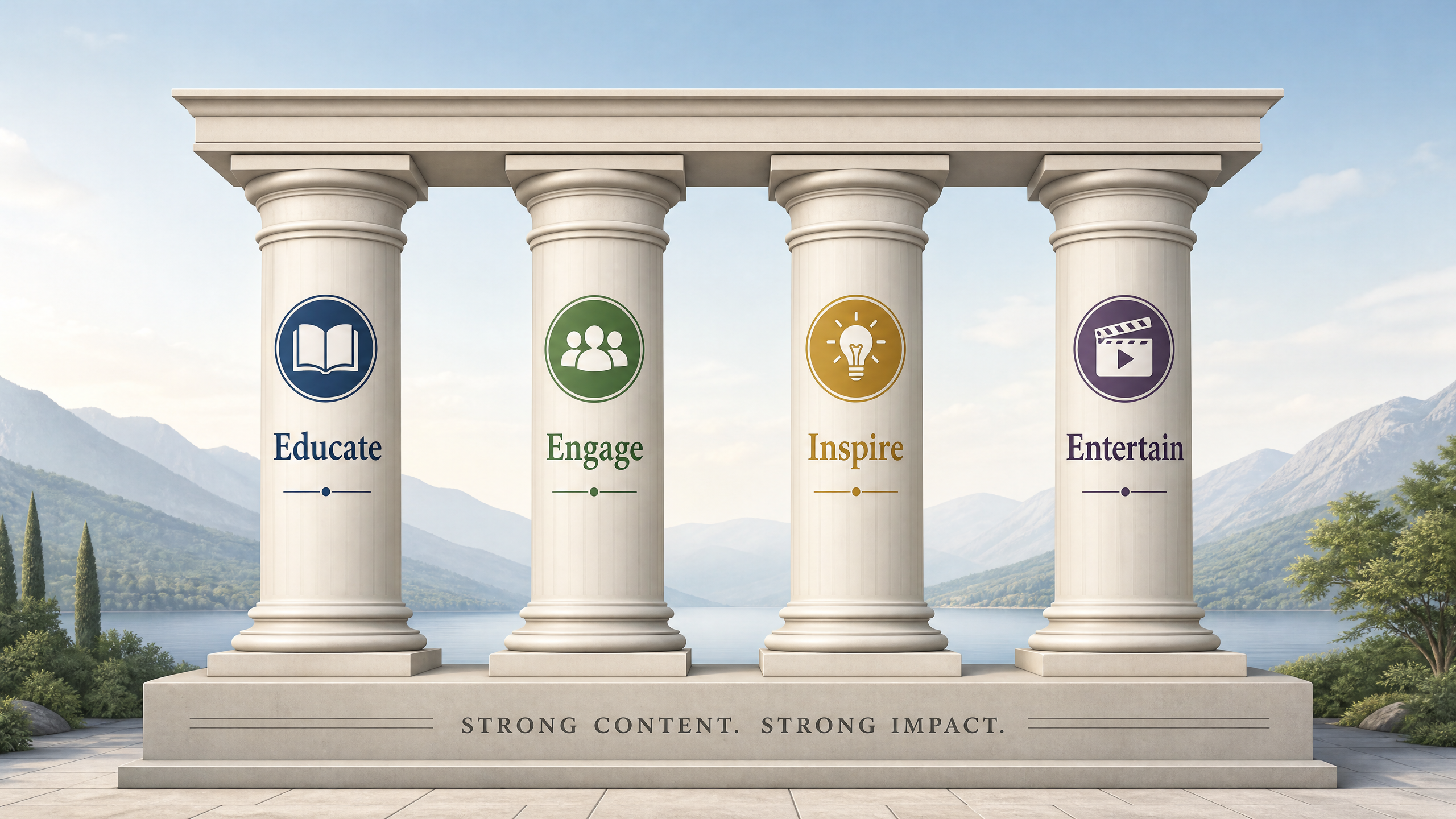
The Core Types of Community Content Pillars
When you are building your template, it helps to understand the different types of pillars you can use. While the specific topics will depend entirely on your niche, the underlying purpose of the content usually falls into one of several broad categories. According to industry experts, there are a few common types of pillars that successful brands and creators leverage (1-3).
First, we have the Educational Pillar. This is where you share your expertise and teach your audience something valuable. For a niche creator, this is often the most important pillar, as it establishes your authority and gives people a concrete reason to follow you. This could include how-to guides, step-by-step tutorials, industry insights, or deep dives into complex topics within your niche. ² The goal here is to solve problems for your community and position yourself as the go-to resource.
Next is the Engaging Pillar. This content is specifically designed to spark conversation and interaction. It is not just about broadcasting information; it is about inviting your audience to participate. This includes polls, open-ended questions, challenges, and prompts that encourage people to share their own experiences in the comments. ² For community builders, this pillar is vital because it transforms a passive audience into an active, connected group of people.
Then we have the Inspiring and Entertaining Pillars. Inspiring content motivates your audience, sharing success stories, overcoming challenges, or highlighting the core values of your community.² Entertaining content, on the other hand, provides a light-hearted break. It could be relatable memes, funny observations about your niche, or behind-the-scenes bloopers. Both of these pillars help to humanise your brand and build a deeper emotional connection with your followers. They show that you are not just a robot dispensing facts but a real person who understands their struggles and shares their sense of humour.

How to Build Your Niche Content Pillar Template
Now that we understand what pillars are and the different types available, let’s get practical. How do you actually build a content pillar template for your specific niche? It requires a bit of introspection and a lot of audience research. You can’t just pick topics out of thin air; they need to be strategically aligned with both your expertise and your community’s needs.
The first step is to assess your interests and expertise. What are you genuinely passionate about? What could you talk about for hours without getting bored? As a niche creator, you are going to be creating a lot of content around these topics, so you need to ensure you have a deep well of knowledge and enthusiasm to draw from. One helpful approach is the “Out → In” theory: start with a broad interest (e.g., fitness) and drill down until you find a specific, underserved niche (e.g., mobility training for desk workers) 3.
The second step is to research your target audience. Who are you trying to reach? What are their biggest pain points, questions, and desires? You need to understand what they are actively searching for online. Look at forums, Reddit threads, and the comment sections of other creators in your broader industry. What questions keep popping up? Your content pillars should be designed to directly address those needs. If your pillars don’t provide value to your specific audience, they will fail, no matter how well-produced the content is.
Finally, you need to define 3 to 5 broad pillars: 1. Once you have your niche and understand your audience, group your ideas into three to five main categories. Why this specific number? Because fewer than three is too narrow and you will run out of ideas, and more than five is too broad and you will dilute your brand message. These pillars should act like the trunk of a tree, strong and central, from which dozens of specific content ideas (the branches) can grow 3. Write these pillars down. They are the official template that will guide every piece of content you create moving forward.

Filling Your Template: The Content Bank Strategy
Having a template with defined pillars is a great start, but a template is useless if it is empty. The next crucial step in this process is to build a content bank for each of your 3 pillars. A content bank is exactly what it sounds like: a centralised repository where you store all of your ideas, drafts, and inspiration, categorised neatly by pillar. This is the secret weapon that prevents creator burnout and ensures you always have something high-quality to post.
To build your content bank, dedicate a specific brainstorming session to each pillar individually. Let’s say one of your pillars is “Industry News and Analysis”. Sit down and list out every possible angle you could take on that topic. What are the current trends? What are the controversial opinions? What are the common misconceptions? Write down every idea, no matter how small or unrefined. The goal is to generate a massive list of potential posts, videos, or articles that fit perfectly within that specific pillar.
Once you have these lists, you can start organising them within your template. You can use a simple spreadsheet, a Notion board, or a dedicated social media management tool. The format doesn’t matter as much as the organisation. When you sit down to create content for the week, you shouldn’t be staring at a blank screen wondering what to talk about. You should be opening your content bank, selecting an idea from one of your pillars, and getting straight to work. This system transforms content creation from a stressful, daily scramble into a streamlined, predictable process.
Furthermore, a content bank allows you to easily diversify your content. A single idea in your bank can be repurposed across multiple formats. A deep-dive blog post can be broken down into a Twitter thread, summarised in an Instagram carousel, and discussed in a short TikTok video. Because the core idea is rooted in one of your established pillars, you know it will resonate with your audience, regardless of the format you choose to deliver it in.

The Importance of Authenticity and Human Connection
As we look toward the future of content creation, especially in 2026 and beyond, there is one pillar that is becoming absolutely non-negotiable for niche creators: Authenticity. In a digital landscape increasingly flooded with AI-generated text and automated responses, consumers are desperately craving real, human connection. ¹ They want to know the person behind the brand. They want to see your face, hear your voice, and understand your values.
This means that your content strategy cannot be purely transactional or purely educational. You must include content that shows your human side. This could involve sharing behind-the-scenes glimpses of your creative process, discussing your failures (like I did at the beginning of this post!), or simply sharing your genuine opinions on topics relevant to your niche.² Authenticity builds trust, and trust is the currency of online communities. If your audience doesn’t trust you, they won’t engage with you, and they certainly won’t buy from you.
According to recent industry reports, consumers explicitly want brands and creators to focus on human-generated content and personalised service in smaller digital spaces. ¹ This is a massive advantage for niche creators. You don’t need to appeal to millions of people; you just need to build a deep, authentic connection with a few thousand (or even a few hundred) dedicated fans. By weaving authenticity into your content pillars—perhaps by having a dedicated “Behind the Scenes” or “Personal Journey” pillar—you differentiate yourself from the faceless corporate accounts and the AI bots.
Remember, people join communities for the content, but they stay for the connection. Your pillars should provide the structure for the content, but your authentic voice must provide the connection. Don’t be afraid to be vulnerable, to show your mistakes, and to let your unique personality shine through. That is what will ultimately make your niche community thrive.
Analyzing and Optimizing Your Pillars Over Time
The final piece of the puzzle is understanding that your content pillar template is not set in stone. It is a living, breathing document that needs to evolve as your community grows and as the digital landscape changes. You cannot simply set your pillars once and forget about them. You must actively analyse and optimise your strategy over time. 3.
This requires paying close attention to your analytics. Which pillars are driving the most engagement? Which ones are generating the most saves and shares? Conversely, which pillars are consistently falling flat? If you notice that your “educational” posts are getting massive traction, but your “entertaining” memes are getting ignored, that is valuable data. It tells you what your specific niche audience actually values. You shouldn’t ignore that data; you should use it to refine your template.
Engaging directly with your audience is another crucial way to optimise your pillars. Ask them what they want to see more of. Run polls, host Q&A sessions, and actually read the comments they leave on your posts. Your community will often tell you exactly what content they need if you are willing to listen. If they keep asking questions about a topic that isn’t currently one of your pillars, it might be time to adjust your strategy and add a new pillar to address that demand.
Ultimately, the goal is to create a feedback loop. You use your pillars to create content, you analyse how the community reacts to that content, and then you use those insights to tweak and improve your pillars for the future. This iterative process ensures that your content strategy remains relevant, engaging, and highly effective over the long term. It is the difference between a creator who stagnates and a creator who builds a lasting, thriving niche community.
References
Diving Deeper into the Post-Privatization Playbook: Beyond the Basics
Let’s expand a bit on what happens after a company like Wendy’s goes private. It’s not just about making a few quick changes and then flipping it. The playbook for private equity, especially for a firm as experienced as Trian, is far more sophisticated and long-term orientated than many realise. They’re not just looking for low-hanging fruit; they’re aiming for a fundamental transformation.
One critical aspect often overlooked is the re-evaluation of the entire business model. When a company is public, there’s an inherent pressure to maintain certain revenue streams and market positions, even if they’re not the most profitable or strategically sound in the long run. Private ownership allows for a radical rethink. This could mean divesting underperforming assets or brands that don’t fit the core strategy, even if those assets contribute to current revenue. It might involve a complete overhaul of the supply chain, renegotiating contracts with suppliers, or even exploring new, unconventional distribution channels that would be too risky for a public company to experiment with.
Consider the potential for aggressive cost-cutting and efficiency drives. Public companies often have layers of bureaucracy and legacy systems that are difficult to dismantle due to shareholder expectations or internal resistance. In a private setting, Trian could implement leaner operational structures, invest heavily in automation (from kitchen processes to back-office functions), and streamline management, all with the singular focus of boosting the bottom line. These changes, while potentially unpopular in the short term, are designed to create a much more agile and profitable enterprise. My own experience with the startup acquisition, where the VC firm pushed for aggressive cost-cutting post-acquisition, showed me how quickly and ruthlessly these changes can be implemented when public scrutiny is removed. It’s a double-edged sword: painful in the moment, but often necessary for long-term survival and growth.
Furthermore, there’s the strategic use of financial engineering. Private equity firms are masters at optimising capital structures. This could involve recapitalising the company with new debt at favourable rates, using the company’s assets as collateral, or even issuing preferred stock to certain investors. The goal is to maximise returns for the private owners by leveraging the company’s balance sheet more aggressively than a public company might dare. This financial dexterity, combined with operational improvements, is what allows private equity to generate significant returns when they eventually exit their investments. It’s a complex dance of debt, equity, and operational excellence, all choreographed to create a more valuable company.
The Evolving Fast-Food Landscape: A Deeper Dive into the Pressures and Opportunities
The fast-food industry is a fascinating microcosm of broader economic and societal trends. Wendy’s situation, and the interest from Trian, is not just about one company; it reflects profound shifts across the entire sector. Let’s unpack some of these pressures and opportunities in more detail.
Consumer Behaviour Shifts: Beyond just healthier options, consumers are increasingly demanding transparency in sourcing, ethical labour practices, and environmentally sustainable operations. Younger generations, in particular, are willing to pay a premium for brands that align with their values. This forces fast-food giants to re-evaluate everything from their ingredient suppliers to their packaging. Adapting to these demands requires significant investment in R&D, supply chain adjustments, and marketing, which can be a drag on short-term earnings for public companies. A private Wendy’s could potentially make these long-term, value-driven investments without immediate pressure from Wall Street.
Technological Disruption: The rise of ghost kitchens, virtual brands, and sophisticated AI-driven analytics is fundamentally changing the competitive landscape. Ghost kitchens, for instance, allow brands to operate multiple concepts from a single shared kitchen, reducing overhead and increasing flexibility. Virtual brands, often delivery-only, can be launched with minimal capital. For an established player like Wendy’s, integrating these new models, or even launching their own, requires a massive strategic pivot. This isn’t just about adding a delivery app; it’s about rethinking the entire customer journey and operational footprint. Private ownership could provide the agility and capital to experiment with these disruptive models more freely.
Labour Market Dynamics: The fast-food industry is notoriously labour-intensive, and rising minimum wages, increased competition for workers, and demands for better benefits are putting immense pressure on margins. Automation, from order kiosks to robotic fry stations, is becoming not just an efficiency play but a necessity. However, implementing widespread automation is a costly and complex undertaking, often met with public scepticism. A private company might have an easier time making these tough decisions and investments, focusing on long-term operational resilience rather than short-term public perception.