I used to open Instagram every morning and feel worse by the time I closed it.
Not dramatically worse. Just a low-level, vague kind of empty. Like I’d technically been around people but hadn’t actually talked to anyone.
I had followers. I was following people back. I was seeing content constantly. But I wasn’t connecting with anyone. Not really.
That’s when I started paying attention to what was happening on the other side of the internet — the smaller, quieter corners where actual conversations were taking place. Community apps. Private servers. Niche forums. Places where people gathered around a shared interest instead of a shared feed.
I’m not going back. And once you find the right one, I doubt you will either.
What Mainstream Social Media Actually Became
Here’s the honest version of what happened to social media.
Facebook started as a place to stay in touch with people you knew. Twitter was a real-time conversation with strangers who had things to say. Instagram was photos shared with friends.
Then the ad models kicked in. Algorithms replaced chronological feeds. Reach became something you had to pay for. Content that made people angry or anxious got pushed further because it kept people scrolling.
Every platform is optimised for attention. Not connection. Not conversation. Just eyes on screen for as long as possible.
You can feel it when you use these apps now. You’re consuming. You’re not really talking. Your posts go into a void and either get traction or disappear, based on rules you can’t see and can’t control.
The comments sections got worse. The ratio of people performing to people actually conversing flipped completely. Even the people you follow, you never really hear from. You see their content. That’s not the same thing.
I’m not being dramatic when I say this: most people using social media daily are lonelier in their online lives than they were ten years ago, despite being technically “more connected” than ever. The numbers are there. The research backs it up. But you already feel it without needing anyone to cite a study at you.
The social part of social media quietly left the room.
What Online Community Apps Actually Are
Community apps are platforms built around shared spaces rather than individual profiles.
The focus isn’t on how many followers you have or how your post performs. The focus is on the room you’re in and the people inside it. Topics. Channels. Threads. Conversations that go somewhere instead of disappearing into an algorithm.
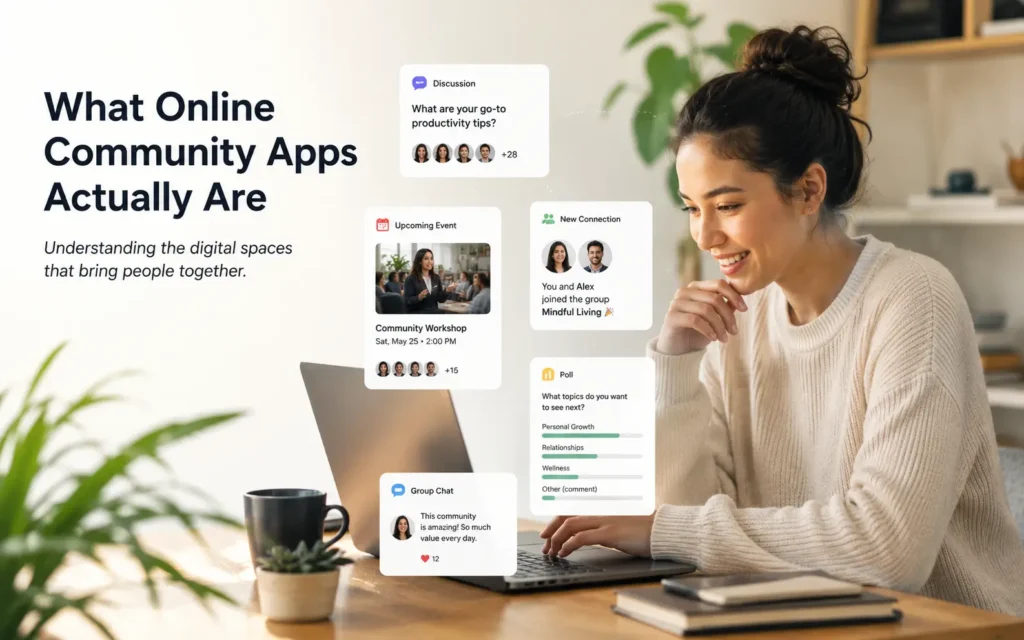
Most of them are organised around interest rather than identity. You’re not there to broadcast yourself. You’re there because you care about something – a hobby, a profession, a goal, a creative pursuit – and you want to find other people who care about the same thing.
That sounds simple. But it’s a completely different experience from anything happening on mainstream platforms right now.
Some of these apps are free. Some charge a subscription. Some are home to millions of communities. Some are tiny spaces with a few hundred people who actually know each other’s names.
The size doesn’t really matter. What matters is whether the conversation is real.
The Time I Tried to Build One Myself and Completely Crashed
Before I talk about the apps worth joining, I have to tell you what happened when I tried to build a community of my own.
I set up a Discord server. I had a clear topic in mind. I designed it properly — separate channels for introductions, resources, off-topic chat, and the works. I invited around 40 people who I thought would be interested. I posted a welcome message. I was excited.
Day one: a few people said hello.
Day three: silence.
Day seven: completely dead. Tumbleweed energy. I posted something to restart the conversation and got two emoji reactions and nothing else.
I shut it down after about two weeks.
The failure taught me something I wish I’d known going in. Building an online community is not the same as building an audience. It’s not about getting people into a room. It’s about giving them a reason to come back to it. Consistently. Over weeks, not days.
You need rituals. Regular events. A reason for people to show up on a Thursday when they have other things going on. I had none of that. I just built the walls and expected the culture to appear.
It doesn’t work that way.
I’m a much better community member now because I failed at being a community builder. And honestly, being a member is a better place to start anyway.
The Best Online Community Apps Worth Actually Trying
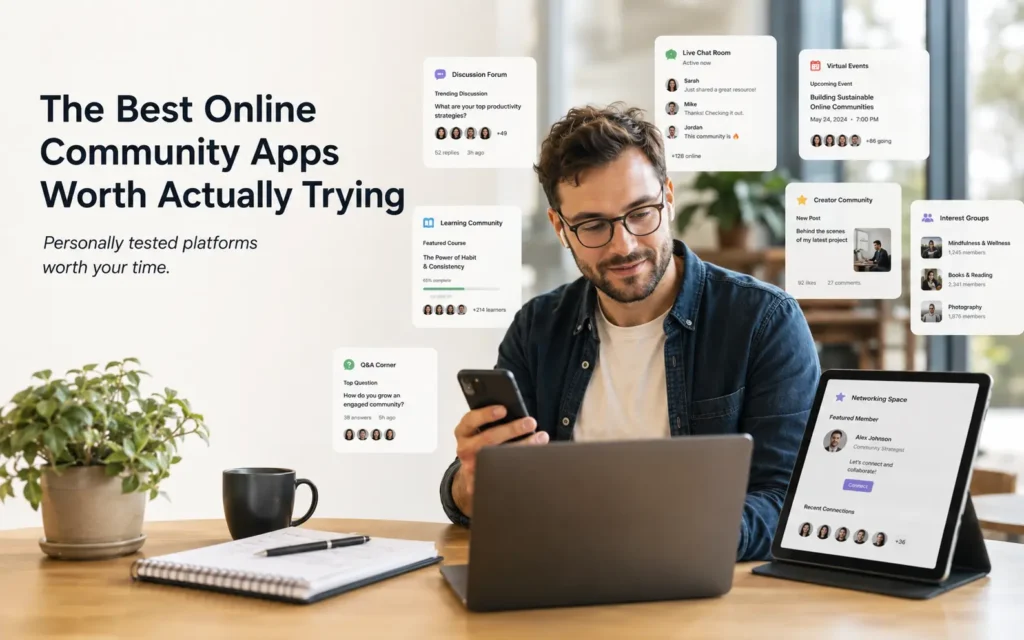
These are the ones I’ve personally used or spent real time in. I’ll tell you what each one is good for and who it’s best suited to.
Discord
Discord started as a voice chat tool for gamers. It’s now home to communities about everything – writing, investing, fitness, film, language learning, mental health, career development, you name it.
A Discord server is organised into channels, which work a bit like separate chat rooms inside one building. There’s usually a general channel, topic-specific channels, and maybe a voice chat room if the community does live sessions. The more organised communities have it clearly mapped out so you know exactly where to go.
The learning curve is real. The interface is dense, and it takes a few days to feel comfortable navigating it. But once you’re in, it’s one of the most active and engaging platforms around.
One thing that surprised me about Discord: voice channels. A lot of communities run regular voice hangouts where people just drop in and talk. It feels more like actually being around people than typing into a chat box does. If you’re someone who finds text-based socialising a little cold, the voice element changes things.
The best Discord communities are the ones with a host who actually shows up. The worst ones go dead within weeks — I can confirm this from personal experience. Look for servers with recent activity before committing. Most servers let you lurk before you post, which I recommend doing for a few days.
Good for: writers, creators, gamers, tech people, anyone with a strong niche interest.
Geneva
Geneva is newer, and it’s genuinely calming compared to Discord.
The interface is clean. Rooms are organised simply. It has a lighter feel and tends to attract communities built around lifestyle, wellness, fashion, and creative work. The vibe skews more toward collaboration than entertainment.
One thing I like about Geneva: it’s genuinely free. No subscription tier, no premium unlock. The whole thing just works. That’s increasingly rare.
If Discord feels overwhelming, Geneva is worth trying first. You get similar functionality without the visual noise.
Good for: people who want community without the complexity.
Reddit is the oldest version of online communities that most people are already using without thinking of it that way.
Subreddits are communities organised by topic. There are subreddits for obscure hobbies, specific professions, niche fandoms, financial discussions, personal struggles, and thousands of things in between. The size ranges from a handful of members to millions.
The anonymity cuts both ways. People say things they’d never say in a named forum. That makes Reddit more raw and sometimes more honest than other platforms — but it also makes some corners of it genuinely unpleasant. You learn quickly which subreddits are worth your time and which ones to avoid.
For pure information-gathering and finding people who share a very specific interest, Reddit is still unmatched. The search is good. The archives go deep. If something has been discussed somewhere, it’s been discussed on Reddit.
Good for: research, niche interests, finding your people by topic.
Mighty Networks
Mighty Networks is a paid community platform. Community builders pay to host their space, and members either pay to join or access it as part of a course, programme, or subscription.
What makes it different is the structure. Mighty Networks is designed for community-plus-content. Creators can run courses, host events, post articles, and manage a discussion space all in one place. It’s more organised than Discord and more interactive than a newsletter.
The communities on Mighty Networks tend to be smaller and more intentional. People usually pay to be there, which changes the energy. You get fewer lurkers and more people who actually want to participate.
If you’re looking for communities tied to a specific course or learning programme, this is likely where they live.
Good for: learners, course communities, professional development.
Circle
Circle is similar to Mighty Networks and serves much the same purpose. Community builders use it to create paid or private spaces attached to their courses or memberships.
The design is cleaner, and the interface is easier to navigate for new members. If you’ve bought access to someone’s paid community and it lives on Circle, you’ll find it intuitive to use within a day or two.
Good for: paid memberships, course communities, structured learning groups.
Substack
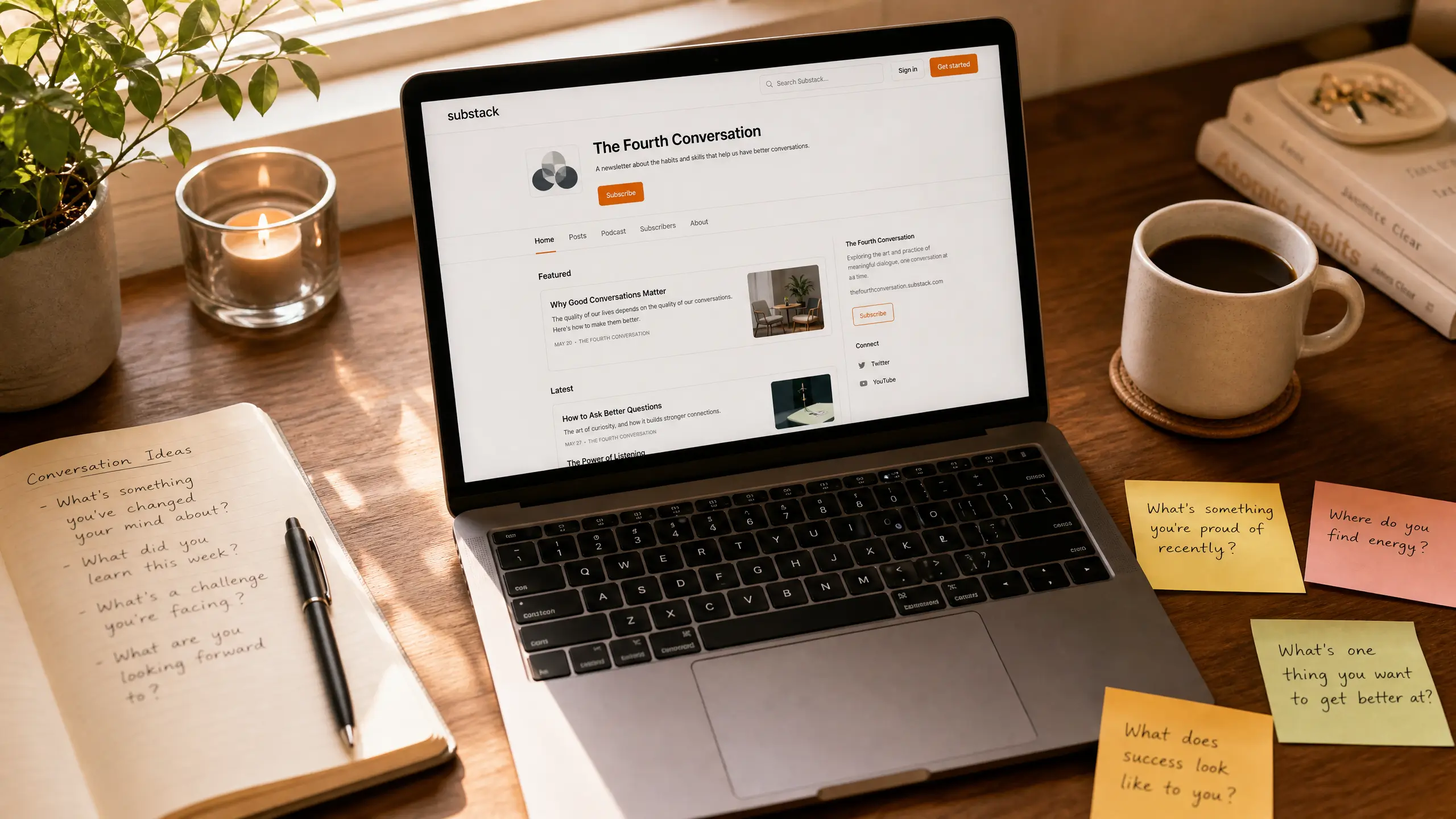
Substack started as a newsletter platform. But its community features have grown quietly in the background.
Writers on Substack can enable comments on their posts. Readers can talk to each other under those posts. Some Substack publications have become genuine gathering points for people who share a strong interest in the writer’s specific corner of the world.
It’s not a standalone community app in the traditional sense. But if you follow a writer whose work you genuinely care about, the comment section can surprise you. I’ve had real conversations with interesting people on Substack that I never would have found on any other platform.
Good for: readers, writers, and anyone already deep into newsletters.
Facebook Groups
I know. Stay with me.
Facebook Groups are not cool. The platform has real problems. But Facebook Groups remain one of the largest active community spaces on the internet, and pretending otherwise doesn’t help anyone.
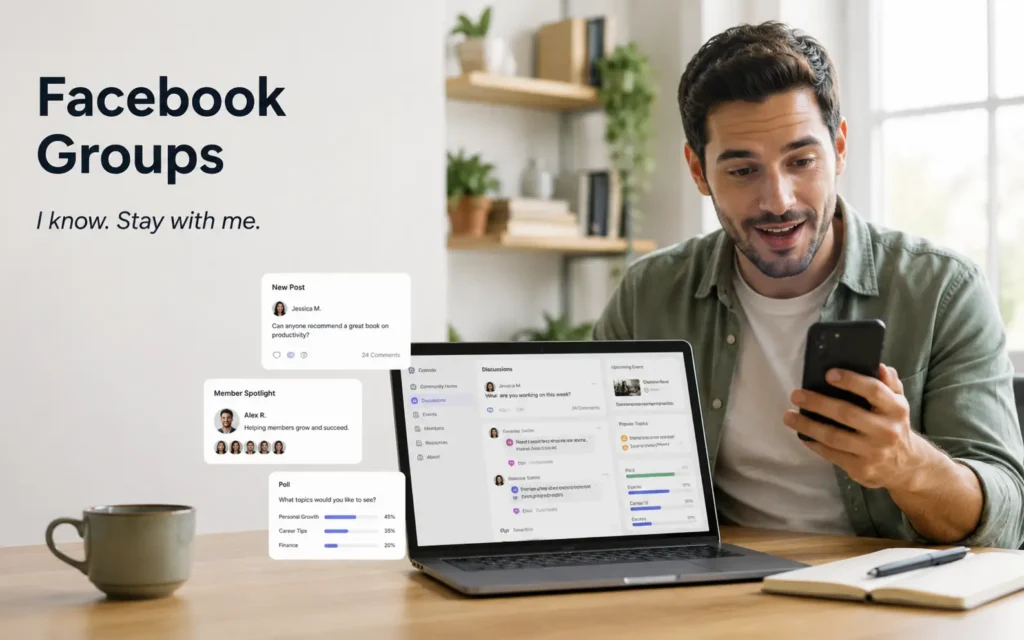
Certain categories of communities are overwhelmingly concentrated on Facebook: local buy-sell groups, parenting communities, hobby groups for older demographics, regional groups, and many professional networks that never migrated elsewhere.
If your people are on Facebook — and depending on the topic, they might be — the group is probably active and well-established. The platform is annoying. The community inside it might be exactly what you’re looking for.
Good for: local groups, older demographics, established niche hobbies.
How to Actually Get Something Out of These Apps
Joining is the easy part. Most people join, lurk for a while, never post, and then quietly drift away after a month.
I’ve done this. It’s how most community memberships end.
Here’s what actually works.
Introduce yourself within the first three days. Most communities have an introductions channel or thread. Use it. A short, honest intro gets you a few responses, which immediately makes the space feel less foreign.
Pick one community to go deep in rather than joining ten. Spreading yourself thin means you never really become part of any of them. Choose one where the topic genuinely matters to you. Give it real attention for a few weeks before adding another.
Post before you feel ready. The fear that nobody will respond, or that you’ll say the wrong thing, keeps a lot of people silent forever. Most communities are more welcoming than your anxiety is telling you they are.
Show up consistently. This sounds obvious. It’s the thing most people don’t do. A community rewards people who keep coming back. The people who post every few days are the ones who end up knowing everyone within a month.
Who Benefits Most From These Apps
These platforms aren’t for everyone. They work best for specific kinds of people.
If you work remotely and miss the incidental conversations that used to happen in an office, community apps are worth trying. That low-level social contact — the kind you don’t notice until it’s gone — is genuinely available in active communities.
If you have a niche interest that nobody in your immediate social circle shares, community apps are often the only place to have the conversation you actually want to have. Talking about obscure topics with people who actually care is a different experience from explaining yourself to people who are politely tolerating it.
If you’re in a career transition or building something new, communities built around that specific goal can be more useful than any amount of content consumption. Knowing that other people are going through the same thing, at the same time, with the same confusion, matters more than most productivity advice.
And if you’re just tired of passive scrolling and want something that actually feels like talking to people, this is the straightforward answer.
My Honest Take
I think the reason people keep chasing connection on Instagram and TikTok is because that’s where the mass of people still are. It feels like the right place to look.

But mass audiences aren’t communities. A thousand followers who vaguely like your content is not the same thing as fifty people who genuinely care about the same thing you do and want to talk about it.
The best social experience I’ve had online in the past two years hasn’t been on any mainstream platform. It’s been in a Discord server for writers, a Substack comment section for a newsletter I genuinely read, and a small Geneva room for people interested in the same professional space I’m trying to break into.
Those conversations felt real. They were useful. I still think about things people said in them.
That’s what connection actually feels like. And you’re not going to find it by optimising your Instagram presence.
The Bottom Line
Mainstream social media is built to keep you watching. Community apps are built to get you talking.
That difference is the whole thing.
Discord, Geneva, Reddit, Mighty Networks, Circle, Substack, and even Facebook Groups – they each have a different feel and a different use case. But they all offer something the big platforms stopped offering a long time ago: a reason to actually engage.
Find the one where your people are. Introduce yourself. Post before you feel ready. Show up more than once.
The connection you’ve been looking for on social media is probably already happening somewhere else. It’s just in a smaller room.
Go find the room.
Nothing in this post is sponsored. Every app mentioned is something I’ve personally used or spent real time researching. Opinions are my own.